Wyckoff Method: Accumulation, Distribution, Spring, Upthrust, Composite Man และ Volume Analysis
Wyckoff Method เป็นวิธีวิเคราะห์ตลาดที่เน้นการอ่าน price action และ volume เพื่อเข้าใจพฤติกรรมของ “smart money” Accumulation คือช่วงที่ institutional investors สะสมหุ้นก่อนราคาจะขึ้น, Distribution คือช่วงกระจายหุ้นก่อนราคาจะลง, Spring คือ false breakdown ที่ดีดกลับอย่างแรง, Upthrust คือ false breakout ที่กลับลงมา, Composite Man คือแนวคิดว่าตลาดถูกควบคุมโดย institutional players และ Volume Analysis ยืนยัน price action
Richard Wyckoff พัฒนาวิธีนี้ในช่วง 1900s-1930s แต่ยังใช้ได้ดีในปัจจุบัน เพราะหลักการพื้นฐานไม่เปลี่ยน: institutional investors ยังคงสะสม (accumulate) ก่อน markup และกระจาย (distribute) ก่อน markdown ราคา Bitcoin, stocks, forex ทั้งหมดแสดง Wyckoff patterns เพราะ market dynamics ไม่เปลี่ยน — เพียงแต่ speed เร็วขึ้น
Wyckoff Laws
| Law | Principle | Application |
|---|---|---|
| Supply and Demand | ราคาขึ้นเมื่อ demand > supply, ลงเมื่อ supply > demand | ดู volume + price spread เพื่อประเมิน supply/demand balance |
| Cause and Effect | ช่วง accumulation/distribution (cause) กำหนดขนาดของ trend (effect) | ยิ่ง accumulation นาน → markup ยิ่งใหญ่ (Point & Figure count) |
| Effort vs Result | Volume (effort) ควรสอดคล้องกับ price movement (result) | High volume + small price move = ผิดปกติ → reversal possible |
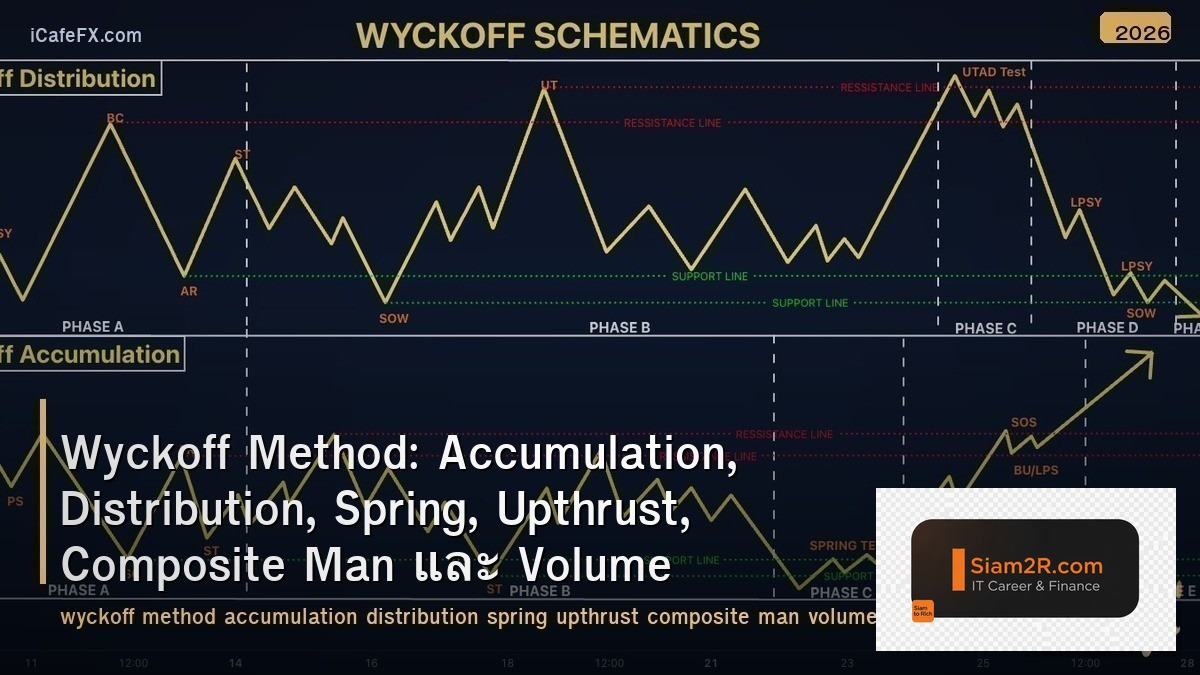
Accumulation Schematic
| Phase | Event | Description |
|---|---|---|
| Phase A | PS (Preliminary Support) | Buying appears after extended downtrend — first sign of support |
| Phase A | SC (Selling Climax) | Panic selling on high volume — wide spread down → sharp reversal |
| Phase A | AR (Automatic Rally) | Short covering + early buyers → quick rally → sets upper boundary of range |
| Phase A | ST (Secondary Test) | Re-test of SC area on lower volume → confirms support established |
| Phase B | Trading Range | Price oscillates between support (SC) and resistance (AR) — institutions accumulate quietly |
| Phase C | Spring / Shakeout | False breakdown below support → trap sellers → sharp reversal up = best buy signal |
| Phase D | SOS (Sign of Strength) | Strong move up on high volume → price breaks above resistance → confirms accumulation complete |
| Phase D | LPS (Last Point of Support) | Pullback to former resistance (now support) on lower volume → last chance to buy |
| Phase E | Markup | Price trends up strongly → accumulation effect plays out → trend continuation |
Distribution Schematic
| Phase | Event | Description |
|---|---|---|
| Phase A | PSY (Preliminary Supply) | Selling appears after extended uptrend — first sign of resistance |
| Phase A | BC (Buying Climax) | Euphoric buying on high volume — wide spread up → sharp reversal |
| Phase A | AR (Automatic Reaction) | Quick sell-off → sets lower boundary of distribution range |
| Phase A | ST (Secondary Test) | Re-test of BC area on lower volume → confirms resistance |
| Phase B | Trading Range | Price oscillates — institutions distribute (sell) to retail buyers |
| Phase C | UTAD (Upthrust After Distribution) | False breakout above resistance → trap buyers → sharp reversal down = sell signal |
| Phase D | SOW (Sign of Weakness) | Strong move down on high volume → breaks below support → confirms distribution |
| Phase D | LPSY (Last Point of Supply) | Weak rally to former support (now resistance) → last chance to sell/short |
| Phase E | Markdown | Price trends down strongly → distribution effect plays out |
Spring vs Upthrust
| Feature | Spring | Upthrust (UTAD) |
|---|---|---|
| Direction | False breakdown below support | False breakout above resistance |
| Context | End of accumulation (Phase C) | End of distribution (Phase C) |
| Volume | Low volume on break → high volume on reversal = strong spring | Low volume on break → high volume on reversal = strong UTAD |
| Purpose | Shakeout weak holders → institutions buy their shares | Trap late buyers → institutions sell to them |
| Signal | Buy signal (strongest in Wyckoff) | Sell/short signal (strongest in Wyckoff) |
| Confirmation | SOS (Sign of Strength) follows — strong move up on volume | SOW (Sign of Weakness) follows — strong move down on volume |
Volume Analysis (Wyckoff)
| Volume + Price | Interpretation |
|---|---|
| High volume + wide spread up | Strong demand — bullish (especially on breakout/SOS) |
| High volume + narrow spread up | Effort without result — supply entering → potential resistance/reversal |
| High volume + wide spread down | Strong supply — bearish (especially on SOW/breakdown) |
| High volume + narrow spread down | Effort without result — demand absorbing → potential support |
| Decreasing volume on rally | Weakening demand — rally losing steam → potential distribution |
| Decreasing volume on decline | Decreasing supply — selling drying up → potential accumulation |
| Volume spike on reversal | Climactic action — selling/buying climax → potential trend change |
ทิ้งท้าย: Wyckoff = Read the Market Through the Eyes of Smart Money
Wyckoff Method Laws: supply/demand, cause/effect (accumulation size = trend size), effort vs result (volume vs price) Accumulation: PS → SC → AR → ST → range → Spring (best buy) → SOS → LPS → Markup Distribution: PSY → BC → AR → ST → range → UTAD (best sell) → SOW → LPSY → Markdown Spring: false breakdown + low volume break + high volume reversal = strongest buy signal Upthrust: false breakout + trap buyers = strongest sell signal Volume: effort vs result — high volume + narrow spread = effort without result → reversal likely Key: Wyckoff ใช้ได้กับทุก market (stocks, crypto, forex) — focus on price + volume + structure ไม่ใช่ indicators
อ่านเพิ่มเติมเกี่ยวกับ Candlestick Patterns Advanced Three Drives Island Reversal และ Mean Reversion Trading Bollinger Bands Z-Score ที่ siam2r.com หรือจาก icafeforex.com และ siamlancard.com
อ่านเพิ่มเติม: วิเคราะห์ทองคำ | XM Signal EA
FAQ
Wyckoff Method: Accumulation, Distribution, Spring, Upthrust, Composite Man และ Volume Analysis คืออะไร?
Wyckoff Method: Accumulation, Distribution, Spring, Upthrust, Composite Man และ Volume Analysis เป็นหัวข้อสำคัญในวงการเทคโนโลยีที่ช่วยให้การทำงานมีประสิทธิภาพมากขึ้น ไม่ว่าจะเป็นด้าน IT, Network หรือ Server Management
ทำไมต้องเรียนรู้เรื่อง Wyckoff Method: Accumulation, Distribution, Spring, Upthrust, Composite Man และ Volume Analysis?
เพราะ Wyckoff Method: Accumulation, Distribution, Spring, Upthrust, Composite Man และ Volume Analysis เป็นทักษะที่ตลาดต้องการสูง และช่วยให้คุณแก้ปัญหาในงานจริงได้อย่างมืออาชีพ การเรียนรู้ตั้งแต่วันนี้จะเป็นประโยชน์ในระยะยาว
Wyckoff Method: Accumulation, Distribution, Spring, Upthrust, Composite Man และ Volume Analysis เหมาะกับผู้เริ่มต้นไหม?
ได้แน่นอนครับ บทความนี้เขียนให้เข้าใจง่าย เหมาะทั้งผู้เริ่มต้นและผู้มีประสบการณ์ มี step-by-step guide พร้อมตัวอย่างให้ทำตามได้ทันที
สิ่งที่คุณจะได้เรียนรู้จากบทความนี้
บทความ Wyckoff Method: Accumulation, Distribution, Spring, Upthrust, Composite Man และ Volume Analysis นี้ครอบคลุมทุกอย่างที่คุณต้องรู้ ตั้งแต่พื้นฐานไปจนถึงการนำไปใช้จริง เขียนจากประสบการณ์จริง ไม่ใช่แค่ทฤษฎี มีตัวอย่างและ step-by-step guide ให้ทำตามได้ทันที
ทำไม Wyckoff Method: Accumulation, Distribution, Spring, Upthrust, Composite Man และ Volume Analysis ถึงน่าสนใจ?
Wyckoff Method: Accumulation, Distribution, Spring, Upthrust, Composite Man และ Volume Analysis เป็นหัวข้อที่กำลังได้รับความสนใจสูงมากในปี 2569 ทั้งจากมือใหม่และผู้เชี่ยวชาญ เพราะมีการเปลี่ยนแปลงและพัฒนาใหม่ๆ อยู่ตลอด การติดตามข้อมูลล่าสุดเป็นสิ่งสำคัญ
FAQ
Wyckoff Method: Accumulation, Distribution, Spring, Upthrust, Composite Man และ Volume Analysis คืออะไร?
อ่านรายละเอียดทั้งหมดในบทความนี้ ครอบคลุมตั้งแต่พื้นฐานไปจนถึงขั้นสูง
iCafeForex | SiamLanCard | Siam2R | XM Signal
สิ่งที่ควรรู้เพิ่มเติมเกี่ยวกับ Wyckoff Method: Accumulation, Distribution, Spring, Upthrust, Composite Man และ Volume Analysis
Wyckoff Method: Accumulation, Distribution, Spring, Upthrust, Composite Man และ Volume Analysis ยังมีมิติอื่นที่น่าสนใจ การศึกษาเพิ่มเติมจะช่วยให้เข้าใจภาพรวมได้ดีขึ้น แนะนำให้อ่านบทความที่เกี่ยวข้องเพิ่มเติมและฝึกปฏิบัติจริง
อ่านเพิ่มเติม: iCafeForex | XM Signal EA ฟรี | SiamLanCard | Siam2R
สิ่งที่ควรรู้เพิ่มเติมเกี่ยวกับ Wyckoff Method: Accumulation, Distribution, Spring, Upthrust, Composite Man และ Volume Analysis
Wyckoff Method: Accumulation, Distribution, Spring, Upthrust, Composite Man และ Volume Analysis ยังมีมิติอื่นที่น่าสนใจ การศึกษาเพิ่มเติมจะช่วยให้เข้าใจภาพรวมได้ดีขึ้น แนะนำให้อ่านบทความที่เกี่ยวข้องเพิ่มเติมและฝึกปฏิบัติจริง
อ่านเพิ่มเติม: iCafeForex | XM Signal EA ฟรี | SiamLanCard | Siam2R
สิ่งที่ควรรู้เพิ่มเติมเกี่ยวกับ Wyckoff Method: Accumulation, Distribution, Spring, Upthrust, Composite Man และ Volume Analysis
Wyckoff Method: Accumulation, Distribution, Spring, Upthrust, Composite Man และ Volume Analysis ยังมีมิติอื่นที่น่าสนใจ การศึกษาเพิ่มเติมจะช่วยให้เข้าใจภาพรวมได้ดีขึ้น แนะนำให้อ่านบทความที่เกี่ยวข้องเพิ่มเติมและฝึกปฏิบัติจริง
อ่านเพิ่มเติม: iCafeForex | XM Signal EA ฟรี | SiamLanCard | Siam2R
สิ่งที่ควรรู้เพิ่มเติมเกี่ยวกับ Wyckoff Method: Accumulation, Distribution, Spring, Upthrust, Composite Man และ Volume Analysis
Wyckoff Method: Accumulation, Distribution, Spring, Upthrust, Composite Man และ Volume Analysis ยังมีมิติอื่นที่น่าสนใจ การศึกษาเพิ่มเติมจะช่วยให้เข้าใจภาพรวมได้ดีขึ้น แนะนำให้อ่านบทความที่เกี่ยวข้องเพิ่มเติมและฝึกปฏิบัติจริง
อ่านเพิ่มเติม: iCafeForex | XM Signal EA ฟรี | SiamLanCard | Siam2R