Wyckoff Method: Accumulation, Distribution, Spring, Upthrust, Composite Man และ Trading Schematics
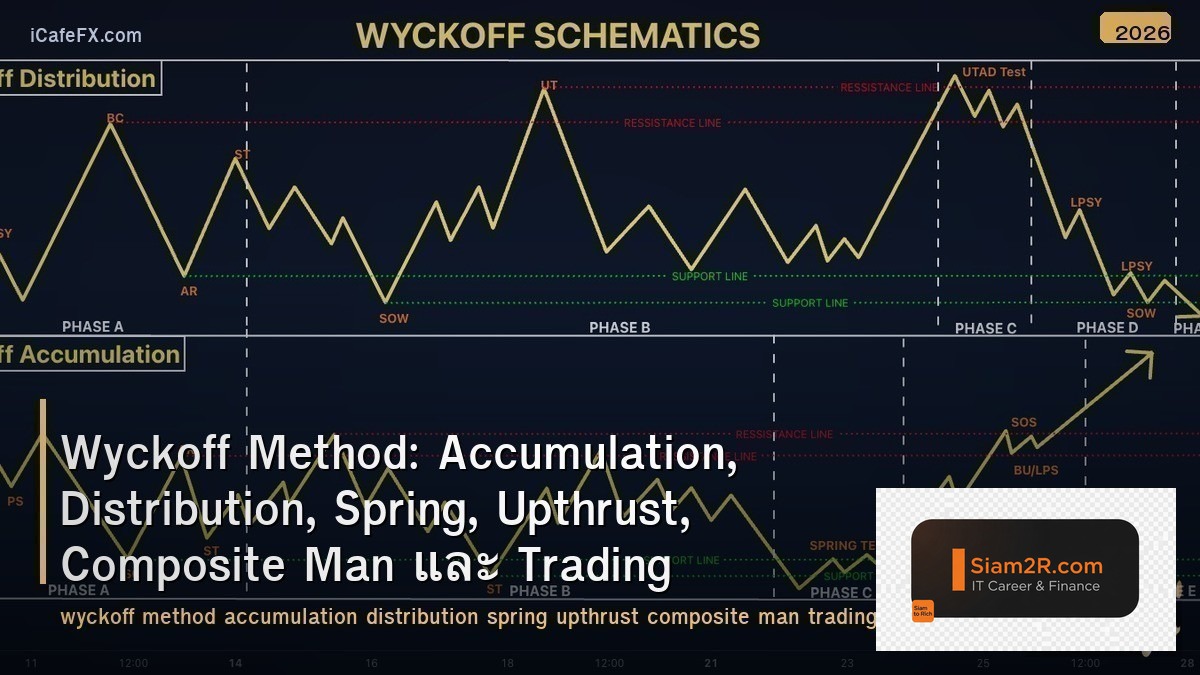
Wyckoff Method วิเคราะห์ price action ผ่านมุมมองของ supply/demand และ smart money Accumulation คือช่วงที่ smart money สะสมหุ้นก่อน markup, Distribution คือช่วงกระจายหุ้นก่อน markdown, Spring เป็น false breakdown ใน accumulation ที่ดักคนขาย, Upthrust เป็น false breakout ใน distribution ที่ดักคนซื้อ, Composite Man คือแนวคิดว่า smart money ควบคุมตลาด และ Trading Schematics เป็น blueprints สำหรับ identify phases
Richard Wyckoff พัฒนา method นี้ในช่วง 1930s โดยศึกษาพฤติกรรมของ Jesse Livermore และ J.P. Morgan แนวคิดหลักคือตลาดถูกขับเคลื่อนโดย “Composite Man” (กลุ่ม smart money) ที่สะสมหุ้นอย่างเงียบๆ แล้ว markup ราคา, กระจายหุ้นให้ retail แล้ว markdown Wyckoff ยังคงใช้ได้ดีในปัจจุบัน เพราะ human psychology ไม่เปลี่ยน
Wyckoff Three Laws
| Law | Description | Application |
|---|---|---|
| Supply and Demand | ราคาขึ้นเมื่อ demand > supply, ลงเมื่อ supply > demand | วิเคราะห์ volume ที่ support/resistance → ใครกำลังชนะ? |
| Cause and Effect | ช่วง trading range (cause) กำหนดขนาดของ trend (effect) | Range กว้าง/นาน → trend ใหญ่ | Range แคบ/สั้น → trend เล็ก |
| Effort vs Result | Volume (effort) ควรสอดคล้องกับ price movement (result) | High volume + small move = absorption | Low volume + big move = lack of participation |
Accumulation Schematic
| Phase | Event | Description |
|---|---|---|
| Phase A | PS (Preliminary Support) | First signs ของ buying interest หลัง downtrend ยาว |
| Phase A | SC (Selling Climax) | Panic selling on high volume → sharp drop → strong reversal bar |
| Phase A | AR (Automatic Rally) | Bounce หลัง SC — short covering + early buying → sets upper range |
| Phase A | ST (Secondary Test) | Retest SC area on lower volume → confirms support |
| Phase B | Trading Range | Smart money สะสมหุ้น quietly → price oscillates in range |
| Phase C | Spring (Test) | False breakdown ต่ำกว่า SC/ST support → trap sellers → reversal on volume |
| Phase D | SOS (Sign of Strength) | Strong rally on high volume → price rises above range → demand > supply confirmed |
| Phase D | LPS (Last Point of Support) | Pullback on low volume → last chance to buy before markup |
| Phase E | Markup | Trend ขึ้นเริ่มต้น → higher highs, higher lows |
Distribution Schematic
| Phase | Event | Description |
|---|---|---|
| Phase A | PSY (Preliminary Supply) | First signs ของ selling pressure หลัง uptrend |
| Phase A | BC (Buying Climax) | Euphoria buying on high volume → sharp spike → reversal |
| Phase A | AR (Automatic Reaction) | Drop หลัง BC → profit taking + early selling → sets lower range |
| Phase A | ST (Secondary Test) | Retest BC area on lower volume → confirms resistance |
| Phase B | Trading Range | Smart money กระจายหุ้น quietly → price oscillates in range |
| Phase C | UTAD (Upthrust After Distribution) | False breakout เหนือ BC resistance → trap buyers → reversal on volume |
| Phase D | SOW (Sign of Weakness) | Strong drop on high volume → price falls below range → supply > demand confirmed |
| Phase D | LPSY (Last Point of Supply) | Weak rally on low volume → last chance to sell/short before markdown |
| Phase E | Markdown | Trend ลงเริ่มต้น → lower highs, lower lows |
Spring vs Upthrust
| Feature | Spring | Upthrust (UTAD) |
|---|---|---|
| Context | Accumulation (bottom) | Distribution (top) |
| Action | False breakdown ต่ำกว่า support | False breakout เหนือ resistance |
| Purpose | Shake out weak holders → smart money buys cheap | Trap late buyers → smart money sells high |
| Volume | Low volume spring = stronger (no real selling) | High volume = test needed | Low volume UTAD = stronger (no real buying) |
| Confirmation | Quick recovery back into range → then SOS (break above) | Quick rejection back into range → then SOW (break below) |
| Trade | Buy on spring with stop below spring low | Short on UTAD with stop above UTAD high |
Composite Man Concept
| Principle | Description |
|---|---|
| Think Like CM | สมมติว่ามี entity เดียวที่ควบคุมตลาด → อ่าน intent จาก price + volume |
| CM Accumulates | ซื้อเงียบๆ ในช่วง trading range → ไม่ให้ราคาขึ้น (absorb supply) |
| CM Marks Up | เมื่อ accumulate พอ → ปล่อยให้ราคาขึ้น (demand > remaining supply) |
| CM Distributes | ขายเงียบๆ ในช่วง trading range → ไม่ให้ราคาลง (absorb demand) |
| CM Marks Down | เมื่อ distribute หมด → ปล่อยให้ราคาลง (supply > remaining demand) |
| CM Uses Traps | Spring/UTAD = deliberate traps เพื่อ shake out weak hands + accumulate/distribute more |
Wyckoff Trading Checklist
| Step | Check |
|---|---|
| 1. Determine Trend | Is the larger trend up, down, or range? (don’t fight the trend) |
| 2. Identify Structure | Is price in accumulation, distribution, markup, or markdown? |
| 3. Look for Spring/UTAD | Has there been a shakeout (false break of support/resistance)? |
| 4. Confirm with Volume | Does volume confirm the move? (SOS on high volume, LPS on low volume) |
| 5. Entry | Enter on Spring (buy), LPS (buy), UTAD (short), LPSY (short) |
| 6. Stop Loss | Below Spring low (longs) or above UTAD high (shorts) |
| 7. Target | Use Point & Figure count or Cause → Effect projection |
ทิ้งท้าย: Wyckoff = Read Smart Money Through Price and Volume
Wyckoff Method Three Laws: supply/demand (who’s winning), cause/effect (range size = trend size), effort/result (volume vs price) Accumulation: SC → AR → ST → range → Spring → SOS → LPS → markup Distribution: BC → AR → ST → range → UTAD → SOW → LPSY → markdown Spring: false breakdown (trap sellers) → buy signal | UTAD: false breakout (trap buyers) → sell signal Composite Man: think like smart money — they accumulate quietly, mark up, distribute, mark down Volume: key confirmation — high volume at reversals, low volume at tests, effort vs result Trading: identify structure → wait for spring/UTAD → confirm with volume → enter with defined risk Key: Wyckoff reveals the game behind the chart — smart money footprints are visible if you know where to look
อ่านเพิ่มเติมเกี่ยวกับ Market Profile TPO Charts Value Area POC และ Order Flow Trading DOM Footprint Charts ที่ siam2r.com หรือจาก icafeforex.com และ siamlancard.com
FAQ
Wyckoff Method: Accumulation, Distribution, Spring, Upthrust, Composite Man และ Trading Schematics คืออะไร?
Wyckoff Method: Accumulation, Distribution, Spring, Upthrust, Composite Man และ Trading Schematics เป็นหัวข้อสำคัญในวงการเทคโนโลยีที่ช่วยให้การทำงานมีประสิทธิภาพมากขึ้น ไม่ว่าจะเป็นด้าน IT, Network หรือ Server Management
ทำไมต้องเรียนรู้เรื่อง Wyckoff Method: Accumulation, Distribution, Spring, Upthrust, Composite Man และ Trading Schematics?
เพราะ Wyckoff Method: Accumulation, Distribution, Spring, Upthrust, Composite Man และ Trading Schematics เป็นทักษะที่ตลาดต้องการสูง และช่วยให้คุณแก้ปัญหาในงานจริงได้อย่างมืออาชีพ การเรียนรู้ตั้งแต่วันนี้จะเป็นประโยชน์ในระยะยาว
Wyckoff Method: Accumulation, Distribution, Spring, Upthrust, Composite Man และ Trading Schematics เหมาะกับผู้เริ่มต้นไหม?
ได้แน่นอนครับ บทความนี้เขียนให้เข้าใจง่าย เหมาะทั้งผู้เริ่มต้นและผู้มีประสบการณ์ มี step-by-step guide พร้อมตัวอย่างให้ทำตามได้ทันที
Wyckoff Method: Accumulation, Distribution, Spring, Upthrust, Composite Man และ Trading Schematics ทำไมถึงสำคัญสำหรับเทรดเดอร์?
Wyckoff Method: Accumulation, Distribution, Spring, Upthrust, Composite Man และ Trading Schematics เป็นหัวข้อที่เทรดเดอร์ทุกระดับควรศึกษาอย่างจริงจัง ไม่ว่าคุณจะเทรด Forex, ทองคำ XAU/USD หรือ Crypto การเข้าใจ Wyckoff Method: Accumulation, Distribution, Spring, Upthrust, Composite Man และ Trading Schematics จะช่วยให้ตัดสินใจเทรดได้ดีขึ้น ลดความเสี่ยง และเพิ่มโอกาสทำกำไรอย่างยั่งยืน จากประสบการณ์ที่ผ่านมา เทรดเดอร์ที่เข้าใจหัวข้อนี้ดีมักจะมี consistency สูงกว่าคนที่เทรดตามสัญชาตญาณ
วิธีนำ Wyckoff Method: Accumulation, Distribution, Spring, Upthrust, Composite Man และ Trading Schematics ไปใช้จริง
การเรียนรู้ทฤษฎีอย่างเดียวไม่พอ ต้องฝึกปฏิบัติจริงด้วย แนะนำให้ทำตามขั้นตอน:
- ศึกษาทฤษฎีให้เข้าใจ — อ่านบทความนี้ให้ครบ ทำความเข้าใจหลักการพื้นฐาน
- ฝึกบน Demo Account — เปิดบัญชี demo แล้วลองใช้ Wyckoff Method: Accumulation, Distribution, Spring, Upthrust, Composite Man และ Trading Schematics กับกราฟจริง ไม่เสี่ยงเงินจริง
- จด Trading Journal — บันทึกทุก trade ที่ใช้เทคนิคนี้ วิเคราะห์ว่าได้ผลเมื่อไหร่ ไม่ได้ผลเมื่อไหร่
- ปรับแต่งให้เข้ากับสไตล์ — ทุกเทคนิคต้องปรับให้เข้ากับ timeframe และ risk tolerance ของคุณ
- เริ่ม live ด้วยเงินน้อย — เมื่อมั่นใจแล้ว เริ่มเทรดจริงด้วย lot size เล็กๆ (0.01-0.05)
เปรียบเทียบ Wyckoff Method: Accumulation, Distribution, Spring, Upthrust, Composite Man และ Trading Schematics กับเทคนิคอื่น
| เทคนิค | ความยาก | ความแม่นยำ | เหมาะกับ |
|---|---|---|---|
| Wyckoff Method: Accumulation, Distribution, Spring, Upthrust, Composite Man และ Trading Schematics | ปานกลาง | สูง (60-70%) | เทรดเดอร์ทุกระดับ |
| Price Action | สูง | สูง (65-75%) | เทรดเดอร์มีประสบการณ์ |
| Smart Money Concepts | สูงมาก | สูงมาก (70%+) | Advanced trader |
| Indicator ง่ายๆ | ต่ำ | ปานกลาง (50-55%) | มือใหม่ |
ข้อผิดพลาดที่พบบ่อยเมื่อใช้ Wyckoff Method: Accumulation, Distribution, Spring, Upthrust, Composite Man และ Trading Schematics
- ไม่รอ confirmation — เห็น signal แล้วเข้าทันทีโดยไม่รอ price action ยืนยัน ทำให้โดน false signal บ่อย
- ใช้ timeframe เล็กเกินไป — M1, M5 noise เยอะ signal ไม่น่าเชื่อถือ แนะนำ H1 ขึ้นไป
- ไม่ดู big picture — ต้องดู higher timeframe (D1/H4) ก่อน แล้วค่อยลง lower TF หา entry
- Over-trading — เห็น signal ทุก candle ไม่ได้แปลว่าต้องเทรดทุกตัว เลือกเฉพาะที่ confluent
- ไม่ใส่ SL — ไม่ว่าจะมั่นใจแค่ไหน ต้องมี Stop Loss เสมอ
FAQ — Wyckoff Method: Accumulation, Distribution, Spring, Upthrust, Composite Man และ Trading Schematics
Wyckoff Method: Accumulation, Distribution, Spring, Upthrust, Composite Man และ Trading Schematics คืออะไร?
Wyckoff Method: Accumulation, Distribution, Spring, Upthrust, Composite Man และ Trading Schematics เป็นเทคนิค/แนวคิดสำหรับการเทรดที่ช่วยให้วิเคราะห์ตลาดได้แม่นยำขึ้น สามารถนำไปใช้กับ Forex, ทองคำ XAU/USD, Crypto และ CFD ต่างๆ ได้
Wyckoff Method: Accumulation, Distribution, Spring, Upthrust, Composite Man และ Trading Schematics เหมาะกับมือใหม่ไหม?
เหมาะครับ แนะนำให้เริ่มฝึกบน Demo Account ก่อน แล้วค่อยเริ่มเทรดจริงเมื่อมั่นใจ บทความนี้อธิบายตั้งแต่พื้นฐาน
Timeframe ไหนเหมาะกับ Wyckoff Method: Accumulation, Distribution, Spring, Upthrust, Composite Man และ Trading Schematics?
H1 และ H4 ดีที่สุดสำหรับ Wyckoff Method: Accumulation, Distribution, Spring, Upthrust, Composite Man และ Trading Schematics ใน trading ทั่วไป D1 สำหรับ swing trading M15 สำหรับ scalping
อ่านเพิ่มเติม: iCafeForex.com | SiamLanCard.com