Volume Spread Analysis (VSA): Smart Money, No Demand, Stopping Volume และ Climax
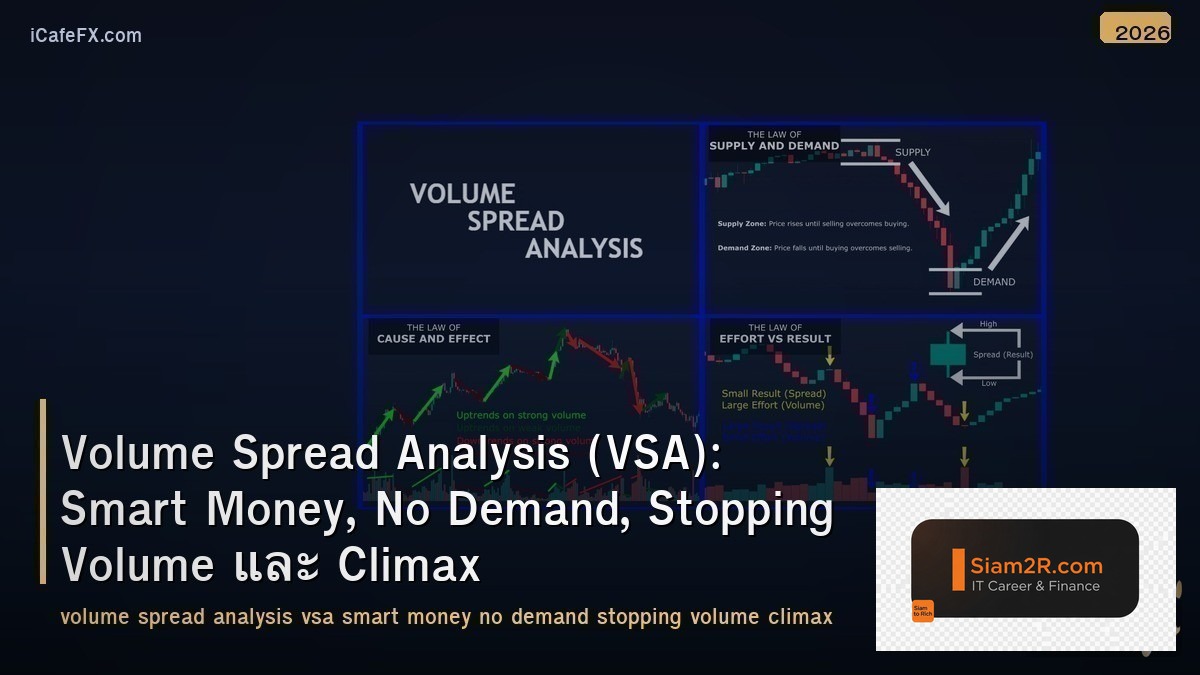
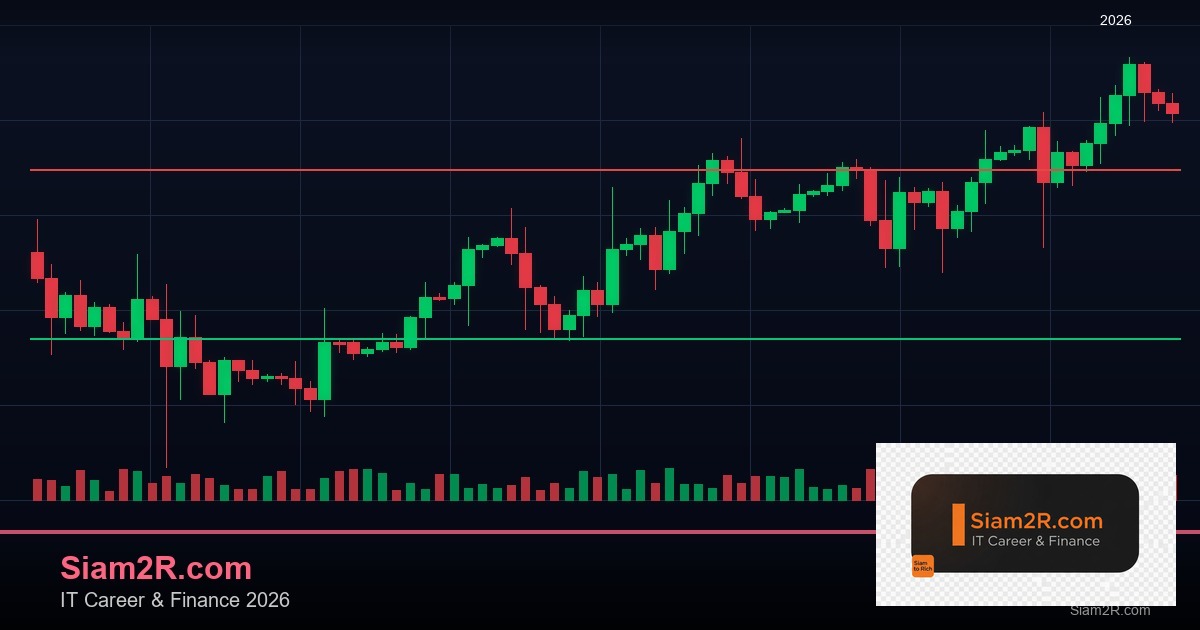
Volume Spread Analysis (VSA) เป็นวิธีวิเคราะห์ตลาดที่พัฒนาจากแนวคิดของ Richard Wyckoff โดย Tom Williams VSA วิเคราะห์ความสัมพันธ์ระหว่าง Volume (ปริมาณการซื้อขาย), Spread (ช่วงราคา high-low ของแท่งเทียน) และ Close (ตำแหน่งที่ราคาปิด) เพื่อระบุ Smart Money activity เช่น No Demand, Stopping Volume, Climax Actions และ Test signals
Indicators ส่วนใหญ่เป็น lagging (ช้ากว่าราคา) แต่ VSA อ่าน real-time supply/demand จาก volume + price action ทำให้เห็นว่า smart money กำลังทำอะไร: สะสม (accumulate), กระจาย (distribute), หรือ test supply/demand ก่อนที่ราคาจะเคลื่อนไหว
VSA Three Elements
| Element | คืออะไร | ดูอย่างไร |
|---|---|---|
| Volume | ปริมาณการซื้อขาย (จำนวน contracts/shares) | สูง/ต่ำ เทียบกับ average (20-bar average) |
| Spread | ช่วง High – Low ของแท่งเทียน | Wide (กว้าง), Narrow (แคบ), Average |
| Close | ตำแหน่งที่ราคาปิดภายในแท่ง | Upper third (strong), Middle, Lower third (weak) |
Key VSA Signals — Bullish
| Signal | Volume | Spread | Close | Meaning |
|---|---|---|---|---|
| Stopping Volume | Very High | Wide down | Middle-Upper | Supply absorbed by demand (smart money buying panic selling) |
| No Supply | Low | Narrow down | Middle-Lower | ไม่มี sellers → downtrend หมดแรง → reversal coming |
| Test (Successful) | Low | Narrow | Near high | Smart money test for remaining supply → ไม่มี supply → bullish |
| Bag Holding (Shakeout) | Very High | Wide down | Upper (close near high) | Massive selling absorbed → strong demand (like Spring) |
| Reverse Upthrust | High | Wide down then recover | Upper | Dip below support + recover → weak shorts trapped |
Key VSA Signals — Bearish
| Signal | Volume | Spread | Close | Meaning |
|---|---|---|---|---|
| Climax Action (Buying Climax) | Very High | Wide up | Middle-Lower | Massive buying met with supply (smart money selling to buyers) |
| No Demand | Low | Narrow up | Middle-Lower | ไม่มี buyers → uptrend หมดแรง → reversal coming |
| Upthrust | High | Wide up | Lower (close near low) | Break above resistance + fail → trap buyers → bearish |
| End of Rising Market | Ultra High | Wide up | Middle | Final push on extreme volume → exhaustion (distribution climax) |
| Supply Overcoming Demand | High | Wide down | Lower | Strong selling → supply in control → bearish continuation |
Effort vs Result
| Scenario | Effort (Volume) | Result (Price Move) | Interpretation |
|---|---|---|---|
| Normal | High volume | Wide spread (big move) | Effort matches result → trend continues |
| Anomaly (Bullish) | High volume | Narrow spread down | Heavy selling but price didn’t drop → absorption (bullish) |
| Anomaly (Bearish) | High volume | Narrow spread up | Heavy buying but price didn’t rise → distribution (bearish) |
| Weakness | Low volume | Wide spread up | Move up on no participation → likely to fail (no demand) |
| Weakness | Low volume | Wide spread down | Move down on no participation → likely to fail (no supply) |
VSA Trading Framework
| Step | Action |
|---|---|
| 1. Identify background | ดู trend context: uptrend, downtrend, or range (VSA signals มี meaning ต่างกันตาม context) |
| 2. Look for climax | หา climax volume ที่ potential turning point (support/resistance) |
| 3. Wait for test | หลัง climax → รอ test (low volume test confirms strength/weakness) |
| 4. Confirm with next bars | ดู follow-through: SOS (strength) หรือ SOW (weakness) bars หลัง test |
| 5. Enter on confirmation | Enter after test + confirmation bar (ไม่ enter บน climax bar เอง) |
| 6. Manage with VSA | Exit เมื่อเห็น opposite VSA signal (no demand ใน long, no supply ใน short) |
VSA + Wyckoff Integration
| Wyckoff Event | VSA Confirmation |
|---|---|
| Selling Climax (SC) | Stopping Volume (very high vol + close upper half) |
| Spring | Shakeout/Bag Holding (high vol + close near high + below support) |
| Test of Spring | Successful Test (low vol + narrow spread + near Spring level) |
| Sign of Strength (SOS) | Wide spread up + high vol + close near high |
| Buying Climax (BC) | Climax Action (very high vol + close lower half) |
| Upthrust (UTAD) | Upthrust bar (high vol + wide spread up + close near low) |
| Sign of Weakness (SOW) | Supply Overcoming Demand (high vol + wide down + close near low) |
Common Mistakes
| Mistake | Solution |
|---|---|
| ดู volume เดี่ยวๆ ไม่ดู context | เปรียบเทียบกับ 20-bar average + ดู background trend |
| Enter บน climax bar ทันที | รอ test + confirmation (climax อาจเป็น continuation ไม่ใช่ reversal) |
| ไม่ดู spread + close | Volume อย่างเดียวไม่พอ → ต้องดู spread + close position ร่วมด้วย |
| ใช้กับ timeframe เล็กเกินไป | VSA ทำงานดีบน 1H+ (4H, Daily best) → timeframe เล็ก = noise มาก |
| ไม่ดู S/R levels | VSA signals ที่ key S/R levels มี reliability สูงกว่า mid-range |
ทิ้งท้าย: VSA = Read Supply and Demand from Volume + Price
Volume Spread Analysis Three elements: Volume + Spread + Close position (ดูร่วมกัน) Bullish: Stopping Volume, No Supply, Successful Test, Shakeout Bearish: Climax Action, No Demand, Upthrust, End of Rising Market Effort vs Result: volume ไม่ match price move = anomaly (reversal signal) Framework: identify background → find climax → wait test → confirm → enter Integration: VSA confirms Wyckoff events (SC, Spring, SOS, BC, UTAD, SOW)
อ่านเพิ่มเติมเกี่ยวกับ Wyckoff Method Advanced และ Order Flow Trading Footprint ที่ siam2r.com หรือจาก icafeforex.com และ siamlancard.com
FAQ
Volume Spread Analysis (VSA): Smart Money, No Demand, Stopping Volume และ Climax คืออะไร?
Volume Spread Analysis (VSA): Smart Money, No Demand, Stopping Volume และ Climax เป็นหัวข้อสำคัญในวงการเทคโนโลยีที่ช่วยให้การทำงานมีประสิทธิภาพมากขึ้น ไม่ว่าจะเป็นด้าน IT, Network หรือ Server Management
ทำไมต้องเรียนรู้เรื่อง Volume Spread Analysis (VSA): Smart Money, No Demand, Stopping Volume และ Climax?
เพราะ Volume Spread Analysis (VSA): Smart Money, No Demand, Stopping Volume และ Climax เป็นทักษะที่ตลาดต้องการสูง และช่วยให้คุณแก้ปัญหาในงานจริงได้อย่างมืออาชีพ การเรียนรู้ตั้งแต่วันนี้จะเป็นประโยชน์ในระยะยาว
Volume Spread Analysis (VSA): Smart Money, No Demand, Stopping Volume และ Climax เหมาะกับผู้เริ่มต้นไหม?
ได้แน่นอนครับ บทความนี้เขียนให้เข้าใจง่าย เหมาะทั้งผู้เริ่มต้นและผู้มีประสบการณ์ มี step-by-step guide พร้อมตัวอย่างให้ทำตามได้ทันที
Volume Spread Analysis (VSA): Smart Money, No Demand, Stopping Volume และ Climax ทำไมถึงสำคัญสำหรับเทรดเดอร์?
Volume Spread Analysis (VSA): Smart Money, No Demand, Stopping Volume และ Climax เป็นหัวข้อที่เทรดเดอร์ทุกระดับควรศึกษาอย่างจริงจัง ไม่ว่าคุณจะเทรด Forex, ทองคำ XAU/USD หรือ Crypto การเข้าใจ Volume Spread Analysis (VSA): Smart Money, No Demand, Stopping Volume และ Climax จะช่วยให้ตัดสินใจเทรดได้ดีขึ้น ลดความเสี่ยง และเพิ่มโอกาสทำกำไรอย่างยั่งยืน จากประสบการณ์ที่ผ่านมา เทรดเดอร์ที่เข้าใจหัวข้อนี้ดีมักจะมี consistency สูงกว่าคนที่เทรดตามสัญชาตญาณ
วิธีนำ Volume Spread Analysis (VSA): Smart Money, No Demand, Stopping Volume และ Climax ไปใช้จริง
การเรียนรู้ทฤษฎีอย่างเดียวไม่พอ ต้องฝึกปฏิบัติจริงด้วย แนะนำให้ทำตามขั้นตอน:
- ศึกษาทฤษฎีให้เข้าใจ — อ่านบทความนี้ให้ครบ ทำความเข้าใจหลักการพื้นฐาน
- ฝึกบน Demo Account — เปิดบัญชี demo แล้วลองใช้ Volume Spread Analysis (VSA): Smart Money, No Demand, Stopping Volume และ Climax กับกราฟจริง ไม่เสี่ยงเงินจริง
- จด Trading Journal — บันทึกทุก trade ที่ใช้เทคนิคนี้ วิเคราะห์ว่าได้ผลเมื่อไหร่ ไม่ได้ผลเมื่อไหร่
- ปรับแต่งให้เข้ากับสไตล์ — ทุกเทคนิคต้องปรับให้เข้ากับ timeframe และ risk tolerance ของคุณ
- เริ่ม live ด้วยเงินน้อย — เมื่อมั่นใจแล้ว เริ่มเทรดจริงด้วย lot size เล็กๆ (0.01-0.05)
เปรียบเทียบ Volume Spread Analysis (VSA): Smart Money, No Demand, Stopping Volume และ Climax กับเทคนิคอื่น
| เทคนิค | ความยาก | ความแม่นยำ | เหมาะกับ |
|---|---|---|---|
| Volume Spread Analysis (VSA): Smart Money, No Demand, Stopping Volume และ Climax | ปานกลาง | สูง (60-70%) | เทรดเดอร์ทุกระดับ |
| Price Action | สูง | สูง (65-75%) | เทรดเดอร์มีประสบการณ์ |
| Smart Money Concepts | สูงมาก | สูงมาก (70%+) | Advanced trader |
| Indicator ง่ายๆ | ต่ำ | ปานกลาง (50-55%) | มือใหม่ |
ข้อผิดพลาดที่พบบ่อยเมื่อใช้ Volume Spread Analysis (VSA): Smart Money, No Demand, Stopping Volume และ Climax
- ไม่รอ confirmation — เห็น signal แล้วเข้าทันทีโดยไม่รอ price action ยืนยัน ทำให้โดน false signal บ่อย
- ใช้ timeframe เล็กเกินไป — M1, M5 noise เยอะ signal ไม่น่าเชื่อถือ แนะนำ H1 ขึ้นไป
- ไม่ดู big picture — ต้องดู higher timeframe (D1/H4) ก่อน แล้วค่อยลง lower TF หา entry
- Over-trading — เห็น signal ทุก candle ไม่ได้แปลว่าต้องเทรดทุกตัว เลือกเฉพาะที่ confluent
- ไม่ใส่ SL — ไม่ว่าจะมั่นใจแค่ไหน ต้องมี Stop Loss เสมอ
FAQ — Volume Spread Analysis (VSA): Smart Money, No Demand, Stopping Volume และ Climax
Volume Spread Analysis (VSA): Smart Money, No Demand, Stopping Volume และ Climax คืออะไร?
Volume Spread Analysis (VSA): Smart Money, No Demand, Stopping Volume และ Climax เป็นเทคนิค/แนวคิดสำหรับการเทรดที่ช่วยให้วิเคราะห์ตลาดได้แม่นยำขึ้น สามารถนำไปใช้กับ Forex, ทองคำ XAU/USD, Crypto และ CFD ต่างๆ ได้
Volume Spread Analysis (VSA): Smart Money, No Demand, Stopping Volume และ Climax เหมาะกับมือใหม่ไหม?
เหมาะครับ แนะนำให้เริ่มฝึกบน Demo Account ก่อน แล้วค่อยเริ่มเทรดจริงเมื่อมั่นใจ บทความนี้อธิบายตั้งแต่พื้นฐาน
Timeframe ไหนเหมาะกับ Volume Spread Analysis (VSA): Smart Money, No Demand, Stopping Volume และ Climax?
H1 และ H4 ดีที่สุดสำหรับ Volume Spread Analysis (VSA): Smart Money, No Demand, Stopping Volume และ Climax ใน trading ทั่วไป D1 สำหรับ swing trading M15 สำหรับ scalping
อ่านเพิ่มเติม: iCafeForex.com | SiamLanCard.com