Mean Reversion Trading: Bollinger Bands, RSI Extremes และ Statistical Edge
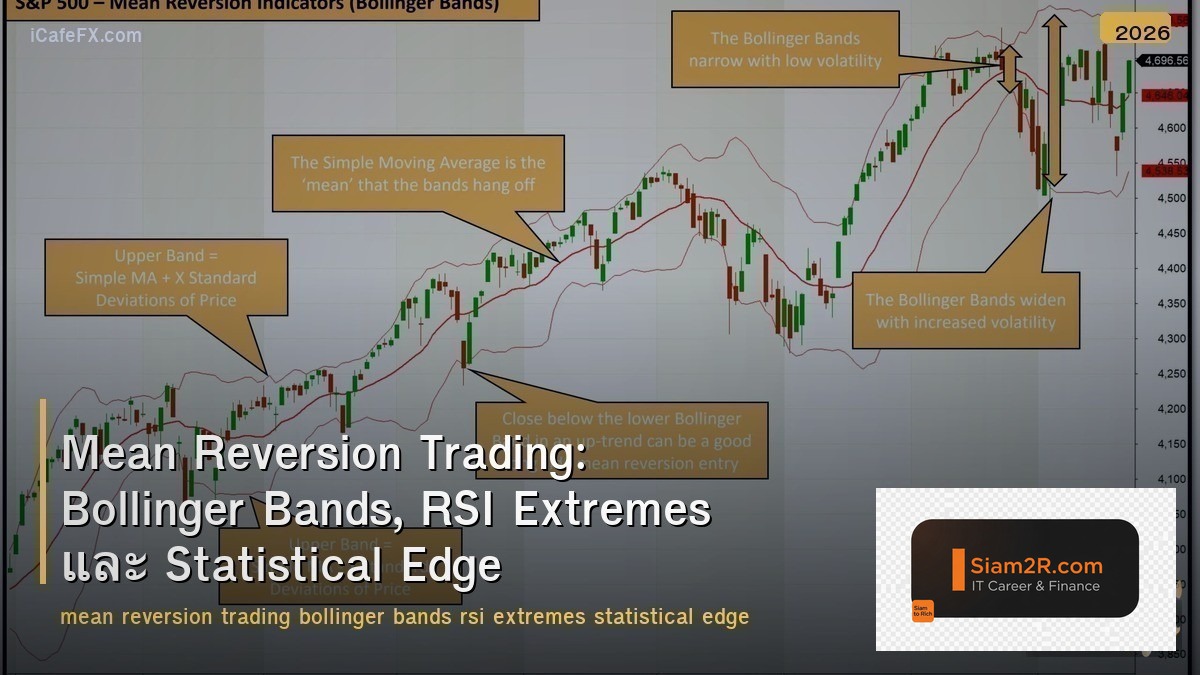
Mean Reversion Trading อิงจากหลักการทางสถิติที่ว่าราคาจะกลับสู่ค่าเฉลี่ย (mean) หลังจากเบี่ยงเบนไปไกล Bollinger Bands วัด standard deviation จาก moving average เพื่อหา overbought/oversold zones, RSI Extremes ใช้ momentum oscillator หา overextended conditions และ Statistical Edge ใช้ z-score + historical probability สำหรับ quantify ว่าราคาเบี่ยงเบนมากแค่ไหน
Trend following strategies ทำกำไรเมื่อตลาด trend แต่ ตลาดอยู่ใน range 60-70% ของเวลา ซึ่ง trend following ไม่ทำงาน Mean reversion ทำกำไรจาก range-bound conditions: ซื้อเมื่อราคาลงมาไกลจาก mean (oversold), ขายเมื่อราคาขึ้นไปไกลจาก mean (overbought) — ทำกำไรจากการกลับสู่ค่าเฉลี่ย
Mean Reversion Concept
| Concept | รายละเอียด |
|---|---|
| Mean (ค่าเฉลี่ย) | Moving Average (SMA/EMA 20, 50) = equilibrium price |
| Deviation | ราคาห่างจาก mean มากแค่ไหน (measured by SD, ATR, RSI) |
| Reversion | ราคามีแนวโน้มกลับสู่ mean หลังจาก extreme deviation |
| Edge | Statistical probability ว่าราคาจะ revert > probability ว่าจะ continue |
| Best Market | Range-bound, choppy, low-trend markets |
| Worst Market | Strong trending markets (mean keeps shifting) |
Bollinger Bands Mean Reversion
| Feature | รายละเอียด |
|---|---|
| Components | Middle Band = SMA(20), Upper = SMA + 2SD, Lower = SMA – 2SD |
| Statistical Basis | ~95% ของราคาอยู่ภายใน ±2SD → price outside bands = statistically extreme |
| Buy Signal | Price touches/pierces lower band → expect reversion to middle band |
| Sell Signal | Price touches/pierces upper band → expect reversion to middle band |
| %B Indicator | (Price – Lower Band) / (Upper – Lower) → 0 = at lower, 1 = at upper |
| Bandwidth | (Upper – Lower) / Middle → narrow = low volatility (squeeze → breakout) |
Bollinger Band Strategies
| Strategy | Setup | Entry | Target | Stop |
|---|---|---|---|---|
| Band Touch Buy | Price touches lower band in range | Buy with bullish candle confirm | Middle band (SMA 20) | Below lower band – 1 ATR |
| Band Touch Sell | Price touches upper band in range | Sell with bearish candle confirm | Middle band | Above upper band + 1 ATR |
| Double Bottom at Band | Two touches of lower band (W pattern) | Buy on second bounce above first low | Upper band | Below double bottom |
| %B Extreme | %B < 0 (below lower band) | Buy when %B crosses back above 0 | %B reaches 0.5 (middle) | %B makes new low |
RSI Mean Reversion
| Feature | รายละเอียด |
|---|---|
| Standard RSI | RSI(14) → overbought > 70, oversold < 30 |
| Short-term RSI | RSI(2) หรือ RSI(3) → more sensitive (overbought > 90, oversold < 10) |
| Connors RSI | Composite: RSI(3) + Streak RSI + % Rank → better mean reversion signals |
| Buy Signal | RSI(2) < 10 → extremely oversold → buy for reversion |
| Sell Signal | RSI(2) > 90 → extremely overbought → sell for reversion |
| Cumulative RSI | Sum of RSI(2) over 2-3 days < 20 → deeper oversold = stronger signal |
RSI(2) Strategy (Larry Connors)
| Rule | Long Setup | Short Setup |
|---|---|---|
| Trend Filter | Price above SMA(200) (uptrend) | Price below SMA(200) (downtrend) |
| Entry Signal | RSI(2) < 5 (extreme oversold) | RSI(2) > 95 (extreme overbought) |
| Entry | Buy at close | Sell at close |
| Exit | Close above SMA(5) | Close below SMA(5) |
| Win Rate | ~75-80% (historically on S&P 500) | ~65-70% |
Statistical Edge: Z-Score
| Feature | รายละเอียด |
|---|---|
| Z-Score | (Price – SMA) / Standard Deviation → measures how many SDs from mean |
| Z = 0 | Price at mean (equilibrium) |
| Z = +2 | Price 2 SDs above mean (overbought, ~2.5% probability of being here) |
| Z = -2 | Price 2 SDs below mean (oversold, ~2.5% probability) |
| Buy Signal | Z-Score < -2 → statistically extreme oversold |
| Sell Signal | Z-Score > +2 → statistically extreme overbought |
| Reversion Target | Z-Score returns toward 0 (mean) |
Mean Reversion Filters
| Filter | Purpose | วิธีใช้ |
|---|---|---|
| Trend Filter | Avoid trading against strong trends | Only buy oversold if above SMA(200), only sell overbought if below |
| Volatility Filter | Adjust for market conditions | BB Bandwidth normal (ไม่ squeeze, ไม่ extreme wide) |
| Volume Confirmation | Confirm institutional activity | High volume on extreme → better reversal probability |
| Multiple Indicators | Increase confidence | RSI(2) < 10 + BB lower band touch + support level = high confidence |
| ADX Filter | Distinguish trend vs range | ADX < 25 = range-bound (mean reversion works), ADX > 30 = trending (avoid) |
Risk Management for Mean Reversion
| Rule | รายละเอียด |
|---|---|
| Stop Loss ที่ต้องมี | Mean reversion ไม่ได้ work 100% → ต้องมี stop (extreme can get more extreme) |
| Position sizing conservative | 1-2% risk เพราะ entries อาจ early (price continues against) |
| Scale in | ซื้อ 1/3 ที่ -2SD → 1/3 ที่ -2.5SD → 1/3 ที่ -3SD (average down within plan) |
| Take profit early | Target = mean (SMA) ไม่ใช่ opposite extreme |
| Max drawdown rule | ถ้า loss > 3-5 consecutive → stop trading, review |
Mean Reversion vs Trend Following
| Feature | Mean Reversion | Trend Following |
|---|---|---|
| Market Type | Range-bound, choppy | Trending, directional |
| Win Rate | High (70-80%) | Low (30-40%) |
| R:R per Trade | Low (1:0.5 – 1:1.5) | High (1:3 – 1:10+) |
| Hold Time | Short (1-5 days typically) | Long (weeks-months) |
| Drawdown Pattern | Small frequent wins + occasional big loss | Many small losses + occasional big win |
| Psychological | Comfortable (high win rate) | Difficult (many losses before big win) |
ทิ้งท้าย: Mean Reversion = Buy Extreme Lows, Sell Extreme Highs
Mean Reversion Principle: price returns to mean after extreme deviation BB: buy at lower band (oversold), sell at upper band (overbought), target = middle RSI(2): < 5-10 = buy, > 90-95 = sell (high win rate ~75%+) Z-Score: < -2 = statistically oversold, > +2 = statistically overbought Filters: trend (SMA 200), volatility (BB width), ADX < 25 (range) Risk: stop loss always, scale in, target = mean not opposite extreme Works best: range-bound markets (60-70% of time)
อ่านเพิ่มเติมเกี่ยวกับ Swing Trading Strategies และ Supply Demand Zone Trading ที่ siam2r.com หรือจาก icafeforex.com และ siamlancard.com
FAQ
Mean Reversion Trading: Bollinger Bands, RSI Extremes และ Statistical Edge คืออะไร?
Mean Reversion Trading: Bollinger Bands, RSI Extremes และ Statistical Edge เป็นหัวข้อสำคัญในวงการเทคโนโลยีที่ช่วยให้การทำงานมีประสิทธิภาพมากขึ้น ไม่ว่าจะเป็นด้าน IT, Network หรือ Server Management
ทำไมต้องเรียนรู้เรื่อง Mean Reversion Trading: Bollinger Bands, RSI Extremes และ Statistical Edge?
เพราะ Mean Reversion Trading: Bollinger Bands, RSI Extremes และ Statistical Edge เป็นทักษะที่ตลาดต้องการสูง และช่วยให้คุณแก้ปัญหาในงานจริงได้อย่างมืออาชีพ การเรียนรู้ตั้งแต่วันนี้จะเป็นประโยชน์ในระยะยาว
Mean Reversion Trading: Bollinger Bands, RSI Extremes และ Statistical Edge เหมาะกับผู้เริ่มต้นไหม?
ได้แน่นอนครับ บทความนี้เขียนให้เข้าใจง่าย เหมาะทั้งผู้เริ่มต้นและผู้มีประสบการณ์ มี step-by-step guide พร้อมตัวอย่างให้ทำตามได้ทันที
Mean Reversion Trading: Bollinger Bands, RSI Extremes และ Statistical Edge ทำไมถึงสำคัญสำหรับเทรดเดอร์?
Mean Reversion Trading: Bollinger Bands, RSI Extremes และ Statistical Edge เป็นหัวข้อที่เทรดเดอร์ทุกระดับควรศึกษาอย่างจริงจัง ไม่ว่าคุณจะเทรด Forex, ทองคำ XAU/USD หรือ Crypto การเข้าใจ Mean Reversion Trading: Bollinger Bands, RSI Extremes และ Statistical Edge จะช่วยให้ตัดสินใจเทรดได้ดีขึ้น ลดความเสี่ยง และเพิ่มโอกาสทำกำไรอย่างยั่งยืน จากประสบการณ์ที่ผ่านมา เทรดเดอร์ที่เข้าใจหัวข้อนี้ดีมักจะมี consistency สูงกว่าคนที่เทรดตามสัญชาตญาณ
วิธีนำ Mean Reversion Trading: Bollinger Bands, RSI Extremes และ Statistical Edge ไปใช้จริง
การเรียนรู้ทฤษฎีอย่างเดียวไม่พอ ต้องฝึกปฏิบัติจริงด้วย แนะนำให้ทำตามขั้นตอน:
- ศึกษาทฤษฎีให้เข้าใจ — อ่านบทความนี้ให้ครบ ทำความเข้าใจหลักการพื้นฐาน
- ฝึกบน Demo Account — เปิดบัญชี demo แล้วลองใช้ Mean Reversion Trading: Bollinger Bands, RSI Extremes และ Statistical Edge กับกราฟจริง ไม่เสี่ยงเงินจริง
- จด Trading Journal — บันทึกทุก trade ที่ใช้เทคนิคนี้ วิเคราะห์ว่าได้ผลเมื่อไหร่ ไม่ได้ผลเมื่อไหร่
- ปรับแต่งให้เข้ากับสไตล์ — ทุกเทคนิคต้องปรับให้เข้ากับ timeframe และ risk tolerance ของคุณ
- เริ่ม live ด้วยเงินน้อย — เมื่อมั่นใจแล้ว เริ่มเทรดจริงด้วย lot size เล็กๆ (0.01-0.05)
เปรียบเทียบ Mean Reversion Trading: Bollinger Bands, RSI Extremes และ Statistical Edge กับเทคนิคอื่น
| เทคนิค | ความยาก | ความแม่นยำ | เหมาะกับ |
|---|---|---|---|
| Mean Reversion Trading: Bollinger Bands, RSI Extremes และ Statistical Edge | ปานกลาง | สูง (60-70%) | เทรดเดอร์ทุกระดับ |
| Price Action | สูง | สูง (65-75%) | เทรดเดอร์มีประสบการณ์ |
| Smart Money Concepts | สูงมาก | สูงมาก (70%+) | Advanced trader |
| Indicator ง่ายๆ | ต่ำ | ปานกลาง (50-55%) | มือใหม่ |
ข้อผิดพลาดที่พบบ่อยเมื่อใช้ Mean Reversion Trading: Bollinger Bands, RSI Extremes และ Statistical Edge
- ไม่รอ confirmation — เห็น signal แล้วเข้าทันทีโดยไม่รอ price action ยืนยัน ทำให้โดน false signal บ่อย
- ใช้ timeframe เล็กเกินไป — M1, M5 noise เยอะ signal ไม่น่าเชื่อถือ แนะนำ H1 ขึ้นไป
- ไม่ดู big picture — ต้องดู higher timeframe (D1/H4) ก่อน แล้วค่อยลง lower TF หา entry
- Over-trading — เห็น signal ทุก candle ไม่ได้แปลว่าต้องเทรดทุกตัว เลือกเฉพาะที่ confluent
- ไม่ใส่ SL — ไม่ว่าจะมั่นใจแค่ไหน ต้องมี Stop Loss เสมอ
FAQ — Mean Reversion Trading: Bollinger Bands, RSI Extremes และ Statistical Edge
Mean Reversion Trading: Bollinger Bands, RSI Extremes และ Statistical Edge คืออะไร?
Mean Reversion Trading: Bollinger Bands, RSI Extremes และ Statistical Edge เป็นเทคนิค/แนวคิดสำหรับการเทรดที่ช่วยให้วิเคราะห์ตลาดได้แม่นยำขึ้น สามารถนำไปใช้กับ Forex, ทองคำ XAU/USD, Crypto และ CFD ต่างๆ ได้
Mean Reversion Trading: Bollinger Bands, RSI Extremes และ Statistical Edge เหมาะกับมือใหม่ไหม?
เหมาะครับ แนะนำให้เริ่มฝึกบน Demo Account ก่อน แล้วค่อยเริ่มเทรดจริงเมื่อมั่นใจ บทความนี้อธิบายตั้งแต่พื้นฐาน
Timeframe ไหนเหมาะกับ Mean Reversion Trading: Bollinger Bands, RSI Extremes และ Statistical Edge?
H1 และ H4 ดีที่สุดสำหรับ Mean Reversion Trading: Bollinger Bands, RSI Extremes และ Statistical Edge ใน trading ทั่วไป D1 สำหรับ swing trading M15 สำหรับ scalping
อ่านเพิ่มเติม: iCafeForex.com | SiamLanCard.com