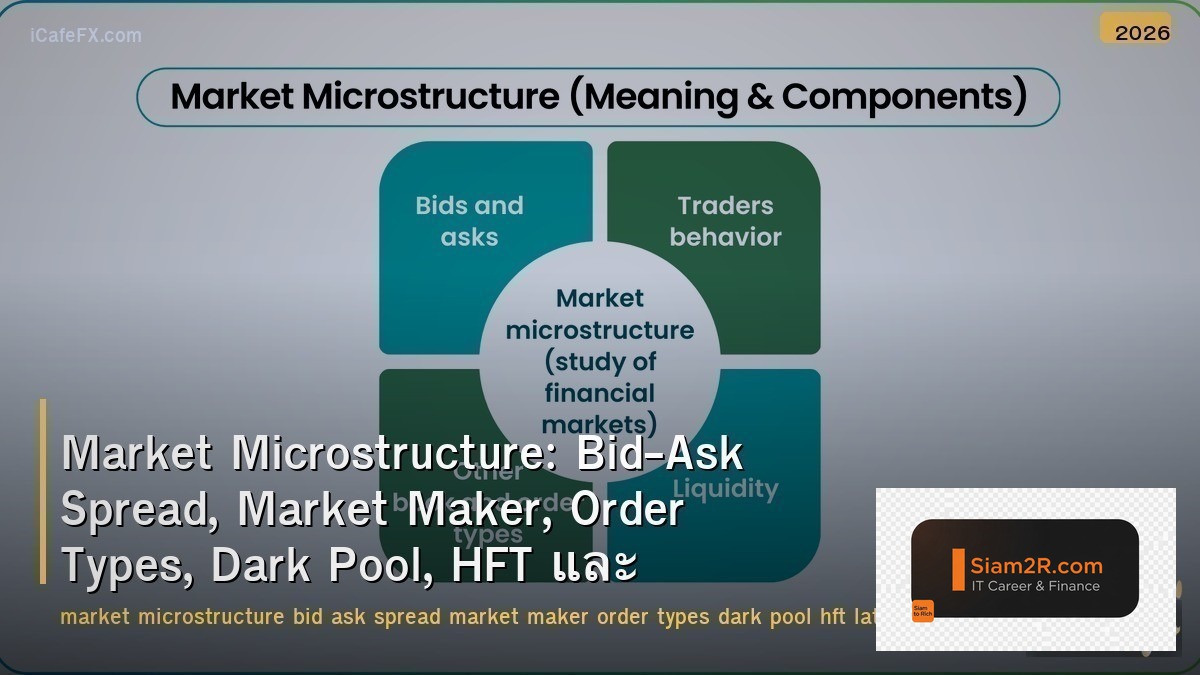
Market Microstructure: Bid-Ask Spread, Market Maker, Order Types, Dark Pool, HFT และ Latency Arbitrage
Market Microstructure ศึกษากลไกภายในของตลาดที่กำหนดราคาและ execution Bid-Ask Spread คือต้นทุนแฝงของการเทรด, Market Maker ให้สภาพคล่อง, Order Types กำหนดวิธี execute, Dark Pool เป็นตลาดที่ไม่เปิดเผย order book, HFT (High-Frequency Trading) เทรดด้วยความเร็วระดับ microsecond และ Latency Arbitrage ทำกำไรจากความเร็วที่ต่างกัน
Market microstructure เป็น ความรู้ที่แยก professional traders ออกจาก retail: retail traders คิดแค่ “ซื้อถูก ขายแพง” แต่ professional traders เข้าใจว่า bid-ask spread คือ cost ที่จ่ายทุกครั้ง, market makers กำไรจาก spread ไม่ใช่ทิศทาง, dark pools ซ่อน institutional orders 40%+ ของ US equity volume, และ HFT firms ทำ 50%+ ของ volume ด้วยการ front-run orders ในระดับ microsecond Understanding microstructure = better execution = lower costs = higher returns
Bid-Ask Spread
| Concept | Detail | Impact |
|---|---|---|
| Bid Price | Highest price buyer willing to pay right now | Price you get when you SELL (market order) |
| Ask Price | Lowest price seller willing to accept right now | Price you pay when you BUY (market order) |
| Spread | Ask – Bid = transaction cost | AAPL: $0.01 (tight) vs penny stock: $0.05-0.50 (wide) |
| Cost Impact | Buy at ask, sell at bid = lose spread immediately | $0.01 spread × 1000 shares × 10 trades/day = $100/day cost |
| Liquidity | Tight spread = liquid (easy to trade) | Wide spread = illiquid (expensive to trade) | Always check spread before trading — especially small caps, options, crypto |
Market Makers
| Feature | Detail |
|---|---|
| Role | Provide continuous bid and ask quotes → ensure liquidity → any time you want to buy/sell, MM is there |
| Profit | Earn bid-ask spread: buy at bid, sell at ask — not directional, profit from spread × volume |
| Obligation | Designated MMs must quote continuously (minimum size, maximum spread) — regulated by exchange |
| Risk | Adverse selection: informed traders trade against MM → MM loses on information asymmetry |
| Hedging | MM hedges inventory: delta-neutral, options hedging → not holding directional risk |
| Major MMs | Citadel Securities, Virtu Financial, Jane Street, Optiver, IMC — dominate US equity/options |
| Crypto MMs | Wintermute, GSR, Jump Crypto, Alameda (defunct) — provide liquidity on CEX and DEX |
Order Types
| Order | How | When to Use |
|---|---|---|
| Market Order | Execute immediately at best available price | Need to enter/exit NOW — accepts slippage for speed |
| Limit Order | Execute at specified price or better | Want specific price — may not fill if price doesn’t reach limit |
| Stop Order | Becomes market order when stop price is hit | Stop loss — exit if price moves against you (may slip) |
| Stop-Limit | Becomes limit order when stop is hit | Stop loss with price control — but may not fill in fast market |
| Iceberg/Reserve | Shows only small portion of total order — hidden size | Large orders — avoid market impact, hide true size from other traders |
| TWAP | Time-Weighted Average Price — split order evenly over time | Institutional — minimize market impact over trading session |
| VWAP | Volume-Weighted Average Price — execute proportional to volume | Institutional benchmark — aim to match or beat VWAP |
Dark Pools
| Feature | Detail |
|---|---|
| What | Private exchange where orders are not displayed in public order book — “dark” because orders are hidden |
| Volume | ~40% of US equity volume trades in dark pools or off-exchange |
| Why | Institutions trade large blocks without moving market price — avoid information leakage and front-running |
| Matching | Often at midpoint of NBBO (national best bid/offer) — better price than lit exchange for both sides |
| Types | Broker-dealer (Goldman, Morgan Stanley), Exchange-owned (BATS, NYSE), Independent (IEX, Liquidnet) |
| Controversy | PFOF (Payment for Order Flow): brokers send retail orders to market makers → better fills? or worse? |
| Regulation | SEC Reg ATS, MiFID II (EU) — increasing transparency requirements |
HFT (High-Frequency Trading)
| Strategy | How | Speed |
|---|---|---|
| Market Making | Automated MM: quote bid/ask thousands of times per second, earn spread | Microseconds — co-located servers at exchange |
| Latency Arbitrage | Same asset on different exchanges has tiny price difference → buy cheap, sell expensive | Nanoseconds — microwave/laser links between exchanges |
| Statistical Arbitrage | ML models find micro-patterns in order flow → trade millisecond-level signals | Milliseconds |
| Momentum Ignition | Place orders to trigger other algos → cancel and trade the resulting move (controversial) | Milliseconds — illegal if manipulative |
| Infrastructure | Co-location, FPGA chips, microwave towers, hollow-core fiber — millions invested in speed | $100M+ investment for nanosecond advantage |
ทิ้งท้าย: Market Microstructure = Understanding How Markets Really Work
Market Microstructure Bid-Ask Spread: transaction cost every trade — tight (liquid, cheap) vs wide (illiquid, expensive) — always check before trading Market Makers: provide liquidity, earn spread, hedge inventory — Citadel, Virtu, Jane Street dominate Order Types: market (speed), limit (price control), stop (protection), iceberg (hide size), TWAP/VWAP (institutional) Dark Pools: 40% of US volume — hide institutional orders, midpoint matching, PFOF controversy HFT: 50%+ of volume — MM, latency arb, stat arb — co-location, FPGA, microwave links — nanosecond race Key: understanding microstructure = better execution, lower costs, avoid being front-run — knowledge asymmetry is the real edge
อ่านเพิ่มเติมเกี่ยวกับ Order Flow Trading Footprint Charts Delta DOM และ Volume Profile POC Value Area HVN LVN ที่ siam2r.com หรือจาก icafeforex.com และ siamlancard.com
FAQ
Market Microstructure: Bid-Ask Spread, Market Maker, Order Types, Dark Pool, HFT และ Latency Arbitrage คืออะไร?
Market Microstructure: Bid-Ask Spread, Market Maker, Order Types, Dark Pool, HFT และ Latency Arbitrage เป็นหัวข้อสำคัญในวงการเทคโนโลยีที่ช่วยให้การทำงานมีประสิทธิภาพมากขึ้น ไม่ว่าจะเป็นด้าน IT, Network หรือ Server Management
ทำไมต้องเรียนรู้เรื่อง Market Microstructure: Bid-Ask Spread, Market Maker, Order Types, Dark Pool, HFT และ Latency Arbitrage?
เพราะ Market Microstructure: Bid-Ask Spread, Market Maker, Order Types, Dark Pool, HFT และ Latency Arbitrage เป็นทักษะที่ตลาดต้องการสูง และช่วยให้คุณแก้ปัญหาในงานจริงได้อย่างมืออาชีพ การเรียนรู้ตั้งแต่วันนี้จะเป็นประโยชน์ในระยะยาว
Market Microstructure: Bid-Ask Spread, Market Maker, Order Types, Dark Pool, HFT และ Latency Arbitrage เหมาะกับผู้เริ่มต้นไหม?
ได้แน่นอนครับ บทความนี้เขียนให้เข้าใจง่าย เหมาะทั้งผู้เริ่มต้นและผู้มีประสบการณ์ มี step-by-step guide พร้อมตัวอย่างให้ทำตามได้ทันที
Market Microstructure: Bid-Ask Spread, Market Maker, Order Types, Dark Pool, HFT และ Latency Arbitrage ทำไมถึงสำคัญสำหรับเทรดเดอร์?
Market Microstructure: Bid-Ask Spread, Market Maker, Order Types, Dark Pool, HFT และ Latency Arbitrage เป็นหัวข้อที่เทรดเดอร์ทุกระดับควรศึกษาอย่างจริงจัง ไม่ว่าคุณจะเทรด Forex, ทองคำ XAU/USD หรือ Crypto การเข้าใจ Market Microstructure: Bid-Ask Spread, Market Maker, Order Types, Dark Pool, HFT และ Latency Arbitrage จะช่วยให้ตัดสินใจเทรดได้ดีขึ้น ลดความเสี่ยง และเพิ่มโอกาสทำกำไรอย่างยั่งยืน จากประสบการณ์ที่ผ่านมา เทรดเดอร์ที่เข้าใจหัวข้อนี้ดีมักจะมี consistency สูงกว่าคนที่เทรดตามสัญชาตญาณ
วิธีนำ Market Microstructure: Bid-Ask Spread, Market Maker, Order Types, Dark Pool, HFT และ Latency Arbitrage ไปใช้จริง
การเรียนรู้ทฤษฎีอย่างเดียวไม่พอ ต้องฝึกปฏิบัติจริงด้วย แนะนำให้ทำตามขั้นตอน:
- ศึกษาทฤษฎีให้เข้าใจ — อ่านบทความนี้ให้ครบ ทำความเข้าใจหลักการพื้นฐาน
- ฝึกบน Demo Account — เปิดบัญชี demo แล้วลองใช้ Market Microstructure: Bid-Ask Spread, Market Maker, Order Types, Dark Pool, HFT และ Latency Arbitrage กับกราฟจริง ไม่เสี่ยงเงินจริง
- จด Trading Journal — บันทึกทุก trade ที่ใช้เทคนิคนี้ วิเคราะห์ว่าได้ผลเมื่อไหร่ ไม่ได้ผลเมื่อไหร่
- ปรับแต่งให้เข้ากับสไตล์ — ทุกเทคนิคต้องปรับให้เข้ากับ timeframe และ risk tolerance ของคุณ
- เริ่ม live ด้วยเงินน้อย — เมื่อมั่นใจแล้ว เริ่มเทรดจริงด้วย lot size เล็กๆ (0.01-0.05)
เปรียบเทียบ Market Microstructure: Bid-Ask Spread, Market Maker, Order Types, Dark Pool, HFT และ Latency Arbitrage กับเทคนิคอื่น
| เทคนิค | ความยาก | ความแม่นยำ | เหมาะกับ |
|---|---|---|---|
| Market Microstructure: Bid-Ask Spread, Market Maker, Order Types, Dark Pool, HFT และ Latency Arbitrage | ปานกลาง | สูง (60-70%) | เทรดเดอร์ทุกระดับ |
| Price Action | สูง | สูง (65-75%) | เทรดเดอร์มีประสบการณ์ |
| Smart Money Concepts | สูงมาก | สูงมาก (70%+) | Advanced trader |
| Indicator ง่ายๆ | ต่ำ | ปานกลาง (50-55%) | มือใหม่ |
ข้อผิดพลาดที่พบบ่อยเมื่อใช้ Market Microstructure: Bid-Ask Spread, Market Maker, Order Types, Dark Pool, HFT และ Latency Arbitrage
- ไม่รอ confirmation — เห็น signal แล้วเข้าทันทีโดยไม่รอ price action ยืนยัน ทำให้โดน false signal บ่อย
- ใช้ timeframe เล็กเกินไป — M1, M5 noise เยอะ signal ไม่น่าเชื่อถือ แนะนำ H1 ขึ้นไป
- ไม่ดู big picture — ต้องดู higher timeframe (D1/H4) ก่อน แล้วค่อยลง lower TF หา entry
- Over-trading — เห็น signal ทุก candle ไม่ได้แปลว่าต้องเทรดทุกตัว เลือกเฉพาะที่ confluent
- ไม่ใส่ SL — ไม่ว่าจะมั่นใจแค่ไหน ต้องมี Stop Loss เสมอ
FAQ — Market Microstructure: Bid-Ask Spread, Market Maker, Order Types, Dark Pool, HFT และ Latency Arbitrage
Market Microstructure: Bid-Ask Spread, Market Maker, Order Types, Dark Pool, HFT และ Latency Arbitrage คืออะไร?
Market Microstructure: Bid-Ask Spread, Market Maker, Order Types, Dark Pool, HFT และ Latency Arbitrage เป็นเทคนิค/แนวคิดสำหรับการเทรดที่ช่วยให้วิเคราะห์ตลาดได้แม่นยำขึ้น สามารถนำไปใช้กับ Forex, ทองคำ XAU/USD, Crypto และ CFD ต่างๆ ได้
Market Microstructure: Bid-Ask Spread, Market Maker, Order Types, Dark Pool, HFT และ Latency Arbitrage เหมาะกับมือใหม่ไหม?
เหมาะครับ แนะนำให้เริ่มฝึกบน Demo Account ก่อน แล้วค่อยเริ่มเทรดจริงเมื่อมั่นใจ บทความนี้อธิบายตั้งแต่พื้นฐาน
Timeframe ไหนเหมาะกับ Market Microstructure: Bid-Ask Spread, Market Maker, Order Types, Dark Pool, HFT และ Latency Arbitrage?
H1 และ H4 ดีที่สุดสำหรับ Market Microstructure: Bid-Ask Spread, Market Maker, Order Types, Dark Pool, HFT และ Latency Arbitrage ใน trading ทั่วไป D1 สำหรับ swing trading M15 สำหรับ scalping
อ่านเพิ่มเติม: iCafeForex.com | SiamLanCard.com