
Behavioral Finance: Loss Aversion, Anchoring, Confirmation Bias, Herd Mentality และ Trading Psychology
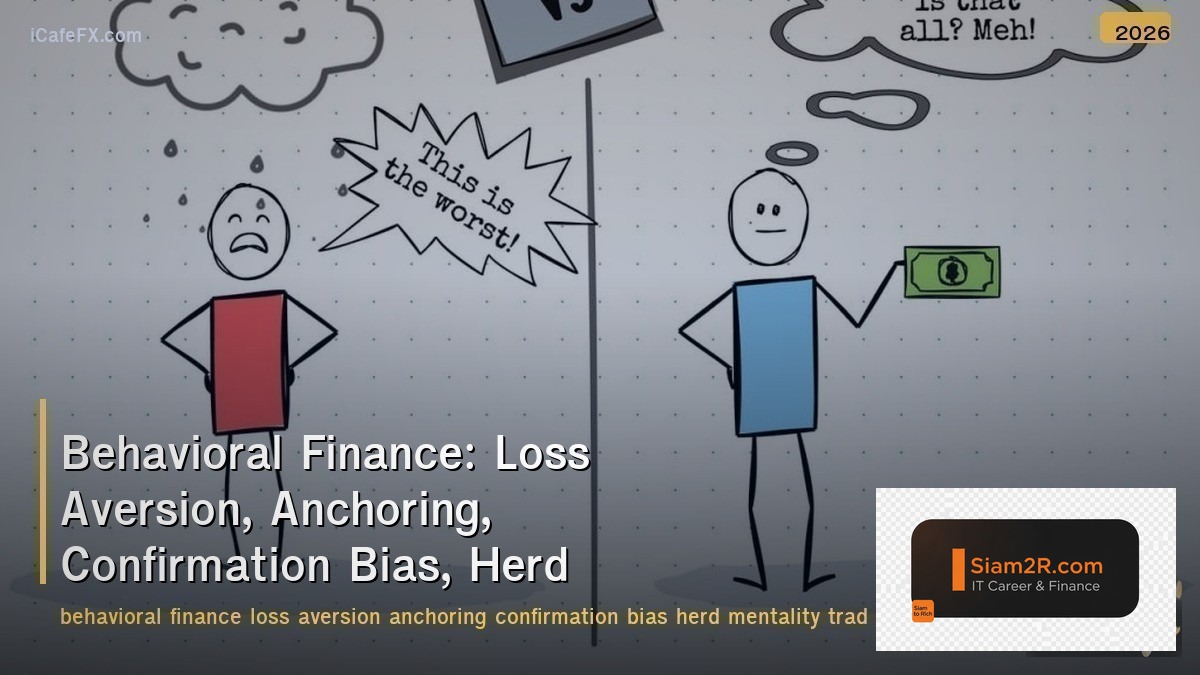
Behavioral Finance ศึกษาว่าจิตวิทยาส่งผลต่อการตัดสินใจทางการเงินอย่างไร Loss Aversion ความเจ็บปวดจากการขาดทุนมากกว่าความสุขจากกำไร, Anchoring ยึดติดกับข้อมูลแรกที่ได้รับ, Confirmation Bias มองหาแต่ข้อมูลที่สนับสนุนความเชื่อเดิม, Herd Mentality ทำตามฝูงชน และ Trading Psychology การจัดการอารมณ์ในการเทรด
Behavioral finance เป็น สาเหตุ #1 ที่นักลงทุนส่วนใหญ่ขาดทุน: ไม่ใช่เพราะ strategy ไม่ดี แต่เพราะจิตวิทยา — Dalbar Study แสดงว่าค่าเฉลี่ยนักลงทุนรายย่อยได้ผลตอบแทน 3.6%/ปี ในขณะที่ S&P 500 ให้ 10.6%/ปี ในช่วงเดียวกัน (ช่วง 30 ปี) ต่างกัน 7%/ปี! สาเหตุ: ซื้อหลังจากขึ้นมาเยอะ (greed/FOMO), ขายหลังจากลงแรง (panic/loss aversion), เทรดบ่อยเกินไป (overconfidence) Daniel Kahneman ได้ Nobel Prize จากงานวิจัย behavioral economics — biases เหล่านี้ฝังอยู่ในสมองมนุษย์
Cognitive Biases ที่ส่งผลต่อการลงทุน
| Bias | Description | Impact on Trading |
|---|---|---|
| Loss Aversion | Pain of losing $100 = 2-2.5x pleasure of gaining $100 (Kahneman & Tversky) | Hold losers too long (hope to break even), sell winners too early (lock in gains) |
| Anchoring | Rely too heavily on first piece of information (anchor) | “I bought at $100 so I’ll sell at $100” — anchor to purchase price, not current fundamentals |
| Confirmation Bias | Seek information that confirms existing belief, ignore contradicting evidence | Bullish on stock → only read bullish analyses, ignore bearish warnings → surprised by decline |
| Herd Mentality | Follow what everyone else is doing — safety in numbers | Buy at the top (everyone’s buying!), sell at the bottom (everyone’s selling!) — worst timing |
| Overconfidence | Overestimate own abilities and knowledge | Trade too frequently, take too much risk, ignore risk management → blow up account |
| Recency Bias | Weight recent events more heavily than long-term data | 3 winning trades → increase size (overconfident) | 3 losses → change strategy (panic) |
| Disposition Effect | Sell winners, hold losers (combination of loss aversion + mental accounting) | Portfolio of losers: cut winners at +5%, hold losers to -50% — inverted risk/reward |
Loss Aversion Deep Dive
| Scenario | Rational Action | Emotional Action |
|---|---|---|
| Stock down 20% | Evaluate: has thesis changed? If yes → cut loss. If no → hold/add | Hold and hope — “it’ll come back” — even if fundamentals deteriorated |
| Stock up 20% | Evaluate: is target reached? If no → hold. If yes → take partial profit | Sell everything — “lock in the gain before it disappears” |
| Breakeven | Irrelevant — future expected return is what matters | Desperate to get back to breakeven — makes irrational decisions to “get even” |
| Averaging Down | Add only if thesis is intact and position sizing allows | Keep buying losers to lower average — throwing good money after bad |
Emotional Cycle of Investing
| Phase | Emotion | Action |
|---|---|---|
| 1. Optimism | Market rising — “This looks promising, let me invest” | Enter position with reasonable expectations |
| 2. Excitement | Position profitable — “I’m good at this!” | May add to position, increase confidence |
| 3. Euphoria | Maximum profit — “I’m a genius! I can’t lose!” | Maximum risk: all-in, leverage, ignore risk management — DANGER POINT |
| 4. Anxiety | Market starts declining — “It’s just a pullback” | Hold and rationalize — “it’ll recover” |
| 5. Denial | Down significantly — “This is temporary, I’m a long-term investor” | Refuse to sell, stop checking portfolio |
| 6. Fear | Down 30-40% — “Maybe I was wrong…” | Consider selling but frozen by loss aversion |
| 7. Panic | Down 50%+ — “Get me out at any price!” | Sell at bottom — maximum loss → WORST POSSIBLE TIMING |
| 8. Capitulation | Sold at bottom — “I’m never investing again” | Completely exit market → miss the recovery |
| 9. Depression | Market recovers without you — “I sold at the worst time” | Stay on sidelines as market recovers → eventually FOMO back in → cycle repeats |
Trading Psychology Solutions
| Problem | Solution | Implementation |
|---|---|---|
| Loss Aversion | Pre-defined stop loss — decide BEFORE entering trade | Set stop loss at entry: “I will exit at -5% regardless of emotion” |
| FOMO / Herd | Trading plan with specific entry criteria | Checklist: entry only when 3/5 criteria met — no checklist = no trade |
| Overconfidence | Fixed position sizing — never risk > 1-2% per trade | Even after 10 wins: same position size. Winning streak ≠ increase risk |
| Confirmation Bias | Actively seek disconfirming evidence | For every bullish reason, find a bearish one. If you can’t find bearish thesis → look harder |
| Recency Bias | Review long-term track record, not last 3 trades | Trading journal: review 100+ trades for statistics, not recent memory |
| Revenge Trading | Daily loss limit — stop trading after X% loss | “If I lose 3% in a day, I turn off the computer” — no exceptions |
| All Biases | Trading journal — write down every trade with reasoning and emotion | Weekly review: what bias affected me? What would I do differently? — self-awareness is the cure |
ทิ้งท้าย: Behavioral Finance = Your Biggest Edge or Your Biggest Enemy
Behavioral Finance Key Biases: loss aversion (pain 2.5x gain), anchoring (stuck on entry price), confirmation bias (ignore contrary evidence), herd (follow crowd), overconfidence (trade too much) Emotional Cycle: optimism → euphoria (max risk!) → panic → capitulation (sell bottom!) → depression → FOMO → repeat Loss Aversion: hold losers too long, sell winners too early → disposition effect = portfolio of losers Solutions: pre-defined stop loss, trading checklist, fixed position sizing (1-2%), seek disconfirming evidence, daily loss limit Trading Journal: write every trade + emotion + reasoning → weekly review → self-awareness cures most biases Key: the Dalbar Study gap (3.6% vs 10.6%) is entirely behavioral — master your psychology = master the market
อ่านเพิ่มเติมเกี่ยวกับ Market Sentiment Analysis Fear Greed Index VIX COT และ Position Sizing Kelly Criterion Fixed Fractional ที่ siam2r.com หรือจาก icafeforex.com และ siamlancard.com
FAQ
Behavioral Finance: Loss Aversion, Anchoring, Confirmation Bias, Herd Mentality และ Trading Psychology คืออะไร?
Behavioral Finance: Loss Aversion, Anchoring, Confirmation Bias, Herd Mentality และ Trading Psychology เป็นหัวข้อสำคัญในวงการเทคโนโลยีที่ช่วยให้การทำงานมีประสิทธิภาพมากขึ้น ไม่ว่าจะเป็นด้าน IT, Network หรือ Server Management
ทำไมต้องเรียนรู้เรื่อง Behavioral Finance: Loss Aversion, Anchoring, Confirmation Bias, Herd Mentality และ Trading Psychology?
เพราะ Behavioral Finance: Loss Aversion, Anchoring, Confirmation Bias, Herd Mentality และ Trading Psychology เป็นทักษะที่ตลาดต้องการสูง และช่วยให้คุณแก้ปัญหาในงานจริงได้อย่างมืออาชีพ การเรียนรู้ตั้งแต่วันนี้จะเป็นประโยชน์ในระยะยาว
Behavioral Finance: Loss Aversion, Anchoring, Confirmation Bias, Herd Mentality และ Trading Psychology เหมาะกับผู้เริ่มต้นไหม?
ได้แน่นอนครับ บทความนี้เขียนให้เข้าใจง่าย เหมาะทั้งผู้เริ่มต้นและผู้มีประสบการณ์ มี step-by-step guide พร้อมตัวอย่างให้ทำตามได้ทันที
Behavioral Finance: Loss Aversion, Anchoring, Confirmation Bias, Herd Mentality และ Trading Psychology ทำไมถึงสำคัญสำหรับเทรดเดอร์?
Behavioral Finance: Loss Aversion, Anchoring, Confirmation Bias, Herd Mentality และ Trading Psychology เป็นหัวข้อที่เทรดเดอร์ทุกระดับควรศึกษาอย่างจริงจัง ไม่ว่าคุณจะเทรด Forex, ทองคำ XAU/USD หรือ Crypto การเข้าใจ Behavioral Finance: Loss Aversion, Anchoring, Confirmation Bias, Herd Mentality และ Trading Psychology จะช่วยให้ตัดสินใจเทรดได้ดีขึ้น ลดความเสี่ยง และเพิ่มโอกาสทำกำไรอย่างยั่งยืน จากประสบการณ์ที่ผ่านมา เทรดเดอร์ที่เข้าใจหัวข้อนี้ดีมักจะมี consistency สูงกว่าคนที่เทรดตามสัญชาตญาณ
วิธีนำ Behavioral Finance: Loss Aversion, Anchoring, Confirmation Bias, Herd Mentality และ Trading Psychology ไปใช้จริง
การเรียนรู้ทฤษฎีอย่างเดียวไม่พอ ต้องฝึกปฏิบัติจริงด้วย แนะนำให้ทำตามขั้นตอน:
- ศึกษาทฤษฎีให้เข้าใจ — อ่านบทความนี้ให้ครบ ทำความเข้าใจหลักการพื้นฐาน
- ฝึกบน Demo Account — เปิดบัญชี demo แล้วลองใช้ Behavioral Finance: Loss Aversion, Anchoring, Confirmation Bias, Herd Mentality และ Trading Psychology กับกราฟจริง ไม่เสี่ยงเงินจริง
- จด Trading Journal — บันทึกทุก trade ที่ใช้เทคนิคนี้ วิเคราะห์ว่าได้ผลเมื่อไหร่ ไม่ได้ผลเมื่อไหร่
- ปรับแต่งให้เข้ากับสไตล์ — ทุกเทคนิคต้องปรับให้เข้ากับ timeframe และ risk tolerance ของคุณ
- เริ่ม live ด้วยเงินน้อย — เมื่อมั่นใจแล้ว เริ่มเทรดจริงด้วย lot size เล็กๆ (0.01-0.05)
เปรียบเทียบ Behavioral Finance: Loss Aversion, Anchoring, Confirmation Bias, Herd Mentality และ Trading Psychology กับเทคนิคอื่น
| เทคนิค | ความยาก | ความแม่นยำ | เหมาะกับ |
|---|---|---|---|
| Behavioral Finance: Loss Aversion, Anchoring, Confirmation Bias, Herd Mentality และ Trading Psychology | ปานกลาง | สูง (60-70%) | เทรดเดอร์ทุกระดับ |
| Price Action | สูง | สูง (65-75%) | เทรดเดอร์มีประสบการณ์ |
| Smart Money Concepts | สูงมาก | สูงมาก (70%+) | Advanced trader |
| Indicator ง่ายๆ | ต่ำ | ปานกลาง (50-55%) | มือใหม่ |
ข้อผิดพลาดที่พบบ่อยเมื่อใช้ Behavioral Finance: Loss Aversion, Anchoring, Confirmation Bias, Herd Mentality และ Trading Psychology
- ไม่รอ confirmation — เห็น signal แล้วเข้าทันทีโดยไม่รอ price action ยืนยัน ทำให้โดน false signal บ่อย
- ใช้ timeframe เล็กเกินไป — M1, M5 noise เยอะ signal ไม่น่าเชื่อถือ แนะนำ H1 ขึ้นไป
- ไม่ดู big picture — ต้องดู higher timeframe (D1/H4) ก่อน แล้วค่อยลง lower TF หา entry
- Over-trading — เห็น signal ทุก candle ไม่ได้แปลว่าต้องเทรดทุกตัว เลือกเฉพาะที่ confluent
- ไม่ใส่ SL — ไม่ว่าจะมั่นใจแค่ไหน ต้องมี Stop Loss เสมอ
FAQ — Behavioral Finance: Loss Aversion, Anchoring, Confirmation Bias, Herd Mentality และ Trading Psychology
Behavioral Finance: Loss Aversion, Anchoring, Confirmation Bias, Herd Mentality และ Trading Psychology คืออะไร?
Behavioral Finance: Loss Aversion, Anchoring, Confirmation Bias, Herd Mentality และ Trading Psychology เป็นเทคนิค/แนวคิดสำหรับการเทรดที่ช่วยให้วิเคราะห์ตลาดได้แม่นยำขึ้น สามารถนำไปใช้กับ Forex, ทองคำ XAU/USD, Crypto และ CFD ต่างๆ ได้
Behavioral Finance: Loss Aversion, Anchoring, Confirmation Bias, Herd Mentality และ Trading Psychology เหมาะกับมือใหม่ไหม?
เหมาะครับ แนะนำให้เริ่มฝึกบน Demo Account ก่อน แล้วค่อยเริ่มเทรดจริงเมื่อมั่นใจ บทความนี้อธิบายตั้งแต่พื้นฐาน
Timeframe ไหนเหมาะกับ Behavioral Finance: Loss Aversion, Anchoring, Confirmation Bias, Herd Mentality และ Trading Psychology?
H1 และ H4 ดีที่สุดสำหรับ Behavioral Finance: Loss Aversion, Anchoring, Confirmation Bias, Herd Mentality และ Trading Psychology ใน trading ทั่วไป D1 สำหรับ swing trading M15 สำหรับ scalping
อ่านเพิ่มเติม: iCafeForex.com | SiamLanCard.com