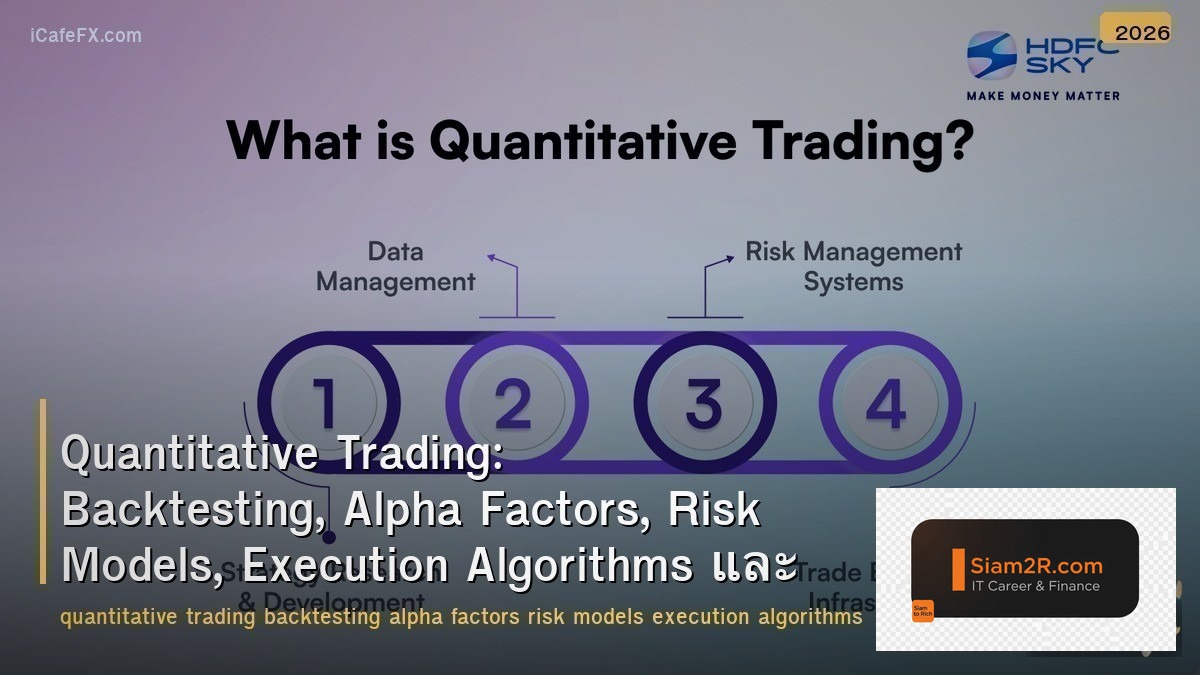
Quantitative Trading: Backtesting, Alpha Factors, Risk Models, Execution Algorithms และ Infrastructure
Quantitative Trading ใช้ mathematical models และ algorithms ในการตัดสินใจ trade Backtesting ทดสอบ strategy กับ historical data, Alpha Factors ค้นหา signals ที่ทำนายผลตอบแทน, Risk Models จัดการความเสี่ยงอย่างเป็นระบบ, Execution Algorithms ลด market impact เมื่อ execute orders ขนาดใหญ่ และ Infrastructure รองรับ data processing และ low-latency trading
Quantitative funds manage $1 trillion+ ในสินทรัพย์: Renaissance Technologies (Medallion Fund ให้ผลตอบแทน 66% ต่อปีก่อนหักค่าธรรมเนียม), Two Sigma, DE Shaw, Citadel ข้อดีของ quant trading คือ systematic (ไม่มี emotion), scalable (trade หลายตลาดพร้อมกัน), backtestable (ทดสอบก่อน deploy) แต่ต้องใช้ expertise ทั้ง finance, math, programming
Quant Trading Pipeline
| Stage | Activity | Output |
|---|---|---|
| 1. Research | Explore data → find patterns → formulate hypothesis | Alpha signal ideas |
| 2. Alpha Development | Build alpha factors → test statistical significance | Validated alpha factors |
| 3. Backtesting | Test strategy on historical data → evaluate performance | Backtest results (Sharpe, drawdown, etc.) |
| 4. Risk Model | Build risk constraints → position sizing → portfolio construction | Risk-adjusted portfolio |
| 5. Execution | Route orders → minimize market impact → execution algorithms | Filled orders with low slippage |
| 6. Monitoring | Live P&L, risk metrics, alpha decay, system health | Real-time dashboards + alerts |
Backtesting
| Feature | รายละเอียด |
|---|---|
| คืออะไร | จำลอง strategy กับ historical data → ประเมิน performance ก่อน deploy จริง |
| In-Sample | Data ที่ใช้ develop strategy (training set) — ระวัง overfitting |
| Out-of-Sample | Data ที่ไม่เคยเห็น (test set) — validation ที่แท้จริง |
| Walk-Forward | Rolling window: train on N years → test on next year → roll forward → repeat |
| Transaction Costs | ต้อง include: commission, spread, slippage, market impact — ไม่ include = results too optimistic |
| Survivorship Bias | ต้อง include delisted stocks — ถ้าใช้แค่ stocks ที่ survive = upward bias |
| Look-Ahead Bias | ใช้ data ที่ยังไม่มี ณ เวลานั้น (เช่น quarterly earnings ก่อน announce) = invalid |
Key Backtest Metrics
| Metric | Formula / Description | Good Value |
|---|---|---|
| Sharpe Ratio | (Return – Risk-Free) / Std Dev → risk-adjusted return | > 1.5 (> 2.0 excellent) |
| Sortino Ratio | Like Sharpe but only penalizes downside volatility | > 2.0 |
| Max Drawdown | Largest peak-to-trough decline | < 20% (< 10% ideal) |
| Calmar Ratio | Annual Return / Max Drawdown | > 1.0 |
| Win Rate | % of profitable trades | Depends on strategy (mean reversion > 50%, trend < 50%) |
| Profit Factor | Gross Profit / Gross Loss | > 1.5 |
| Annual Turnover | Trading frequency → impacts transaction costs | Lower = less cost drag |
Alpha Factors
| Category | Examples | Horizon |
|---|---|---|
| Momentum | 12-month return (skip last month), 52-week high proximity | Medium-term (3-12 months) |
| Mean Reversion | RSI extremes, Bollinger Band deviation, Z-score | Short-term (1-5 days) |
| Value | P/E, P/B, EV/EBITDA, FCF yield | Long-term (6-18 months) |
| Quality | ROE, profit margin stability, low debt, earnings quality | Long-term |
| Sentiment | News sentiment (NLP), social media, analyst revisions | Short-term (1-10 days) |
| Microstructure | Order flow imbalance, bid-ask spread, volume patterns | Ultra-short (intraday) |
| Alternative Data | Satellite imagery, credit card data, web traffic, job postings | Medium-term |
Risk Models
| Model | Approach | Use |
|---|---|---|
| Factor Risk Model | Decompose risk into common factors (market, size, value, momentum) | Portfolio construction, risk attribution |
| Statistical Risk Model | PCA on returns → extract principal components as risk factors | Data-driven risk factors (no prior assumptions) |
| VaR (Value at Risk) | Max loss at confidence level (e.g., 95% VaR = 2% → 95% chance loss < 2%) | Risk limit monitoring |
| CVaR (Expected Shortfall) | Average loss beyond VaR threshold | Tail risk measurement (better than VaR) |
| Position Limits | Max % per position, sector, country | Diversification enforcement |
| Drawdown Control | Reduce position size when drawdown exceeds threshold | Capital preservation |
Execution Algorithms
| Algorithm | How | Use Case |
|---|---|---|
| TWAP (Time-Weighted) | Split order เท่าๆ กัน ตลอดช่วงเวลา | Simple, predictable execution |
| VWAP (Volume-Weighted) | Execute ตาม historical volume profile (more at high-volume times) | Benchmark matching, large orders |
| Implementation Shortfall | Minimize difference between decision price and execution price | Alpha-sensitive orders (minimize delay cost) |
| Iceberg | Show small portion of order → hide true size | Large orders without signaling intent |
| Sniper/Liquidity Seeking | Scan dark pools and lit markets → execute when liquidity available | Minimize market impact |
| Smart Order Router (SOR) | Route to best venue (exchange, dark pool, ATS) based on price/liquidity | Best execution across venues |
Quant Infrastructure
| Component | Purpose | Tools |
|---|---|---|
| Data Pipeline | Ingest, clean, store market data | Apache Kafka, Arctic, kdb+, PostgreSQL/TimescaleDB |
| Research Platform | Alpha research, backtesting | Python (pandas, numpy), Jupyter, Zipline, Backtrader |
| Execution Engine | Order management, routing | Custom OMS, FIX protocol, broker APIs |
| Risk System | Real-time risk monitoring | Custom dashboards, Prometheus/Grafana |
| Low Latency | Fast market data + execution | C++/Rust, FPGA, co-location, kernel bypass |
| Cloud/Compute | Large-scale backtesting, ML training | AWS/GCP, GPU clusters, Spark |
ทิ้งท้าย: Quantitative Trading = Systematic, Data-Driven Alpha
Quantitative Trading Pipeline: research → alpha development → backtesting → risk model → execution → monitoring Backtesting: in/out-of-sample, walk-forward, include costs, avoid survivorship/look-ahead bias Metrics: Sharpe > 1.5, max drawdown < 20%, Calmar > 1.0, profit factor > 1.5 Alpha: momentum, mean reversion, value, quality, sentiment, microstructure, alternative data Risk: factor models, VaR/CVaR, position limits, drawdown control Execution: TWAP, VWAP, implementation shortfall, iceberg, SOR Infrastructure: data pipeline + research platform + execution engine + risk system Key: quant edge comes from better data, better models, better execution — all three must work together
อ่านเพิ่มเติมเกี่ยวกับ Mean Reversion Trading Bollinger Bands RSI และ Order Flow Trading DOM Footprint Charts ที่ siam2r.com หรือจาก icafeforex.com และ siamlancard.com
FAQ
Quantitative Trading: Backtesting, Alpha Factors, Risk Models, Execution Algorithms และ Infrastructure คืออะไร?
Quantitative Trading: Backtesting, Alpha Factors, Risk Models, Execution Algorithms และ Infrastructure เป็นหัวข้อสำคัญในวงการเทคโนโลยีที่ช่วยให้การทำงานมีประสิทธิภาพมากขึ้น ไม่ว่าจะเป็นด้าน IT, Network หรือ Server Management
ทำไมต้องเรียนรู้เรื่อง Quantitative Trading: Backtesting, Alpha Factors, Risk Models, Execution Algorithms และ Infrastructure?
เพราะ Quantitative Trading: Backtesting, Alpha Factors, Risk Models, Execution Algorithms และ Infrastructure เป็นทักษะที่ตลาดต้องการสูง และช่วยให้คุณแก้ปัญหาในงานจริงได้อย่างมืออาชีพ การเรียนรู้ตั้งแต่วันนี้จะเป็นประโยชน์ในระยะยาว
Quantitative Trading: Backtesting, Alpha Factors, Risk Models, Execution Algorithms และ Infrastructure เหมาะกับผู้เริ่มต้นไหม?
ได้แน่นอนครับ บทความนี้เขียนให้เข้าใจง่าย เหมาะทั้งผู้เริ่มต้นและผู้มีประสบการณ์ มี step-by-step guide พร้อมตัวอย่างให้ทำตามได้ทันที
Quantitative Trading: Backtesting, Alpha Factors, Risk Models, Execution Algorithms และ Infrastructure ทำไมถึงสำคัญสำหรับเทรดเดอร์?
Quantitative Trading: Backtesting, Alpha Factors, Risk Models, Execution Algorithms และ Infrastructure เป็นหัวข้อที่เทรดเดอร์ทุกระดับควรศึกษาอย่างจริงจัง ไม่ว่าคุณจะเทรด Forex, ทองคำ XAU/USD หรือ Crypto การเข้าใจ Quantitative Trading: Backtesting, Alpha Factors, Risk Models, Execution Algorithms และ Infrastructure จะช่วยให้ตัดสินใจเทรดได้ดีขึ้น ลดความเสี่ยง และเพิ่มโอกาสทำกำไรอย่างยั่งยืน จากประสบการณ์ที่ผ่านมา เทรดเดอร์ที่เข้าใจหัวข้อนี้ดีมักจะมี consistency สูงกว่าคนที่เทรดตามสัญชาตญาณ
วิธีนำ Quantitative Trading: Backtesting, Alpha Factors, Risk Models, Execution Algorithms และ Infrastructure ไปใช้จริง
การเรียนรู้ทฤษฎีอย่างเดียวไม่พอ ต้องฝึกปฏิบัติจริงด้วย แนะนำให้ทำตามขั้นตอน:
- ศึกษาทฤษฎีให้เข้าใจ — อ่านบทความนี้ให้ครบ ทำความเข้าใจหลักการพื้นฐาน
- ฝึกบน Demo Account — เปิดบัญชี demo แล้วลองใช้ Quantitative Trading: Backtesting, Alpha Factors, Risk Models, Execution Algorithms และ Infrastructure กับกราฟจริง ไม่เสี่ยงเงินจริง
- จด Trading Journal — บันทึกทุก trade ที่ใช้เทคนิคนี้ วิเคราะห์ว่าได้ผลเมื่อไหร่ ไม่ได้ผลเมื่อไหร่
- ปรับแต่งให้เข้ากับสไตล์ — ทุกเทคนิคต้องปรับให้เข้ากับ timeframe และ risk tolerance ของคุณ
- เริ่ม live ด้วยเงินน้อย — เมื่อมั่นใจแล้ว เริ่มเทรดจริงด้วย lot size เล็กๆ (0.01-0.05)
เปรียบเทียบ Quantitative Trading: Backtesting, Alpha Factors, Risk Models, Execution Algorithms และ Infrastructure กับเทคนิคอื่น
| เทคนิค | ความยาก | ความแม่นยำ | เหมาะกับ |
|---|---|---|---|
| Quantitative Trading: Backtesting, Alpha Factors, Risk Models, Execution Algorithms และ Infrastructure | ปานกลาง | สูง (60-70%) | เทรดเดอร์ทุกระดับ |
| Price Action | สูง | สูง (65-75%) | เทรดเดอร์มีประสบการณ์ |
| Smart Money Concepts | สูงมาก | สูงมาก (70%+) | Advanced trader |
| Indicator ง่ายๆ | ต่ำ | ปานกลาง (50-55%) | มือใหม่ |
ข้อผิดพลาดที่พบบ่อยเมื่อใช้ Quantitative Trading: Backtesting, Alpha Factors, Risk Models, Execution Algorithms และ Infrastructure
- ไม่รอ confirmation — เห็น signal แล้วเข้าทันทีโดยไม่รอ price action ยืนยัน ทำให้โดน false signal บ่อย
- ใช้ timeframe เล็กเกินไป — M1, M5 noise เยอะ signal ไม่น่าเชื่อถือ แนะนำ H1 ขึ้นไป
- ไม่ดู big picture — ต้องดู higher timeframe (D1/H4) ก่อน แล้วค่อยลง lower TF หา entry
- Over-trading — เห็น signal ทุก candle ไม่ได้แปลว่าต้องเทรดทุกตัว เลือกเฉพาะที่ confluent
- ไม่ใส่ SL — ไม่ว่าจะมั่นใจแค่ไหน ต้องมี Stop Loss เสมอ
FAQ — Quantitative Trading: Backtesting, Alpha Factors, Risk Models, Execution Algorithms และ Infrastructure
Quantitative Trading: Backtesting, Alpha Factors, Risk Models, Execution Algorithms และ Infrastructure คืออะไร?
Quantitative Trading: Backtesting, Alpha Factors, Risk Models, Execution Algorithms และ Infrastructure เป็นเทคนิค/แนวคิดสำหรับการเทรดที่ช่วยให้วิเคราะห์ตลาดได้แม่นยำขึ้น สามารถนำไปใช้กับ Forex, ทองคำ XAU/USD, Crypto และ CFD ต่างๆ ได้
Quantitative Trading: Backtesting, Alpha Factors, Risk Models, Execution Algorithms และ Infrastructure เหมาะกับมือใหม่ไหม?
เหมาะครับ แนะนำให้เริ่มฝึกบน Demo Account ก่อน แล้วค่อยเริ่มเทรดจริงเมื่อมั่นใจ บทความนี้อธิบายตั้งแต่พื้นฐาน
Timeframe ไหนเหมาะกับ Quantitative Trading: Backtesting, Alpha Factors, Risk Models, Execution Algorithms และ Infrastructure?
H1 และ H4 ดีที่สุดสำหรับ Quantitative Trading: Backtesting, Alpha Factors, Risk Models, Execution Algorithms และ Infrastructure ใน trading ทั่วไป D1 สำหรับ swing trading M15 สำหรับ scalping
อ่านเพิ่มเติม: iCafeForex.com | SiamLanCard.com